

The cost of using a mortgage broker in the UK depends on the broker’s charging model: fee-free brokers do not charge you for mortgage advice, while fee-charging brokers set their own terms. In 2026, compare the written fee agreement before instructing a broker, and keep lender charges, legal work and any early repayment charge separate from the broker’s fee.
- The cost of using a mortgage broker depends on its fee model, not a universal UK tariff.
- Heron Financial offers fee-free, whole-of-market mortgage advice for UK borrowers.
- Fee-free mortgage advice does not remove lender charges, legal costs or early repayment charges.
- Compare written fee terms, lender coverage and the recommended mortgage before committing.
Why this matters
A broker’s fee and the cost of your mortgage are different things. You need to understand both before deciding whether advice represents good value. A fee-free service removes the borrower’s advice charge; it does not make the mortgage itself free.
Start by understanding how a fee-free mortgage broker makes money. Then check the broker’s service scope and the lender’s mortgage illustration separately. That distinction prevents you from comparing an advice fee with a product fee as though they pay for the same thing.
How much does it cost to use a mortgage broker in the UK?
There is no universal borrower fee for UK mortgage advice. Some brokers operate on a fee-free basis, while others charge a fixed fee, a fee linked to the loan amount, or fees at specified stages of their service.
For your 2026 application, the relevant figure is the charge in your own written agreement—not an advertised example or another borrower’s experience. Check whether that agreement covers advice, arranging the mortgage and any additional work you expect.
| Advice route | What you pay for advice | Best for | Main benefit | Main limitation |
|---|---|---|---|---|
| Fee-free broker | No borrower mortgage advice fee under the agreed service terms | Borrowers seeking advice without a separate broker charge | Removes the borrower’s advice fee | Fee-free does not establish lender coverage or guarantee approval |
| Fee-charging broker | The charge stated in the broker’s agreement | Borrowers whose required service matches the broker’s stated scope | Lets you assess a defined service against its charge | Creates an additional payment obligation; refund terms need checking |
| Direct lender | Check the lender’s own advice and application terms | Borrowers who want to consider a particular lender | Direct access to that lender’s mortgage range | Does not compare other lenders’ mortgages |
Choose the advice route on service scope and mortgage suitability, not the fee label alone. A fee-charging broker is not automatically more capable, and a fee-free broker is not automatically whole-of-market.
Fee-free mortgage advice
A fee-free broker does not charge you a borrower fee for the mortgage advice service described in its agreement. Mortgage brokers can receive a lender payment, commonly called a procuration fee, when a mortgage completes. Ask the broker to explain its remuneration and disclose any other charges that apply to your instruction.
The advantage is clear: you can obtain mortgage advice without a separate borrower advice charge. The limitation is equally important. You still need to establish which lenders the broker considers, what work it undertakes and whether your circumstances fit its service.
Fee-charging mortgage advice
A fee-charging broker sets out a payment obligation in its terms. The agreement should explain the fee calculation, payment trigger and cancellation or refund conditions. Read those provisions before authorising work, rather than waiting until an application has been submitted.
A clearly defined service gives you something concrete to evaluate. The drawback is the additional charge, particularly where payment becomes due before completion or remains payable if the application does not proceed. Do not assume that paying a fee buys access to a mortgage unavailable elsewhere.
What costs sit outside the broker’s fee?
Your 2026 mortgage budget needs separate headings for advice, borrowing and the property transaction. Combining them into a single total without identifying who receives each payment makes offers harder to compare. Ask for a breakdown that names the recipient, payment date and refund conditions.
Lender charges
A mortgage can carry a product or arrangement fee, valuation charge and other charges identified in the lender’s documents. These are not the broker’s advice fee. Whether a particular charge applies depends on the mortgage you select.
If a lender allows a fee to be added to the mortgage, adding it to the balance means paying interest on it under the mortgage terms. Check the effect on the total borrowing cost, not just the cash required at application. Ask for a like-for-like comparison with the fee paid separately.
Legal work and surveys
Conveyancing is separate from mortgage broking. Your solicitor or conveyancer handles the legal transaction, and its charges and disbursements need their own budget. Check what any lender legal arrangement includes before assuming that all legal work is covered.
A lender’s valuation is also different from a survey commissioned for your own benefit. The valuation helps the lender assess its security; a buyer’s survey examines the property under the chosen survey scope. Confirm which service you are arranging and who pays for it.
Existing mortgage charges
An early repayment charge can apply when you repay or change an existing mortgage within the period specified by your lender. A fee-free broker does not remove that contractual obligation. Check your existing mortgage terms and obtain the relevant redemption information before deciding to switch.
For a remortgage, compare the proposed mortgage with the cost of leaving the current arrangement. A lower interest rate alone does not establish that switching is worthwhile. The timing of the change and the charges attached to it belong in the same decision.
Why the cost of using a mortgage broker varies
The broker’s written terms determine the charge. These factors explain what to check rather than predicting what your own bill will be:
- Charging model: Establish whether the service is fee-free, fixed-fee, linked to the mortgage amount or charged in stages. Check how the calculation works.
- Service scope: Confirm whether the agreement covers advice and arranging the mortgage, and ask what happens if the recommended lender changes.
- Payment trigger: Identify whether payment becomes due on instruction, application, offer or completion. Those events are not interchangeable.
- Additional work: Ask whether a change in circumstances or a fresh application creates a further charge under the agreement.
- Cancellation terms: Find out whether withdrawal, a declined application or a failed property transaction affects your payment obligation or refund entitlement.
Self-employment, company ownership and landlord borrowing create different advice requirements. They do not, by themselves, prove that a borrower must pay a broker fee. The question is whether the broker accepts the case and what terms apply to that service.
How do you compare mortgage broker fees properly?
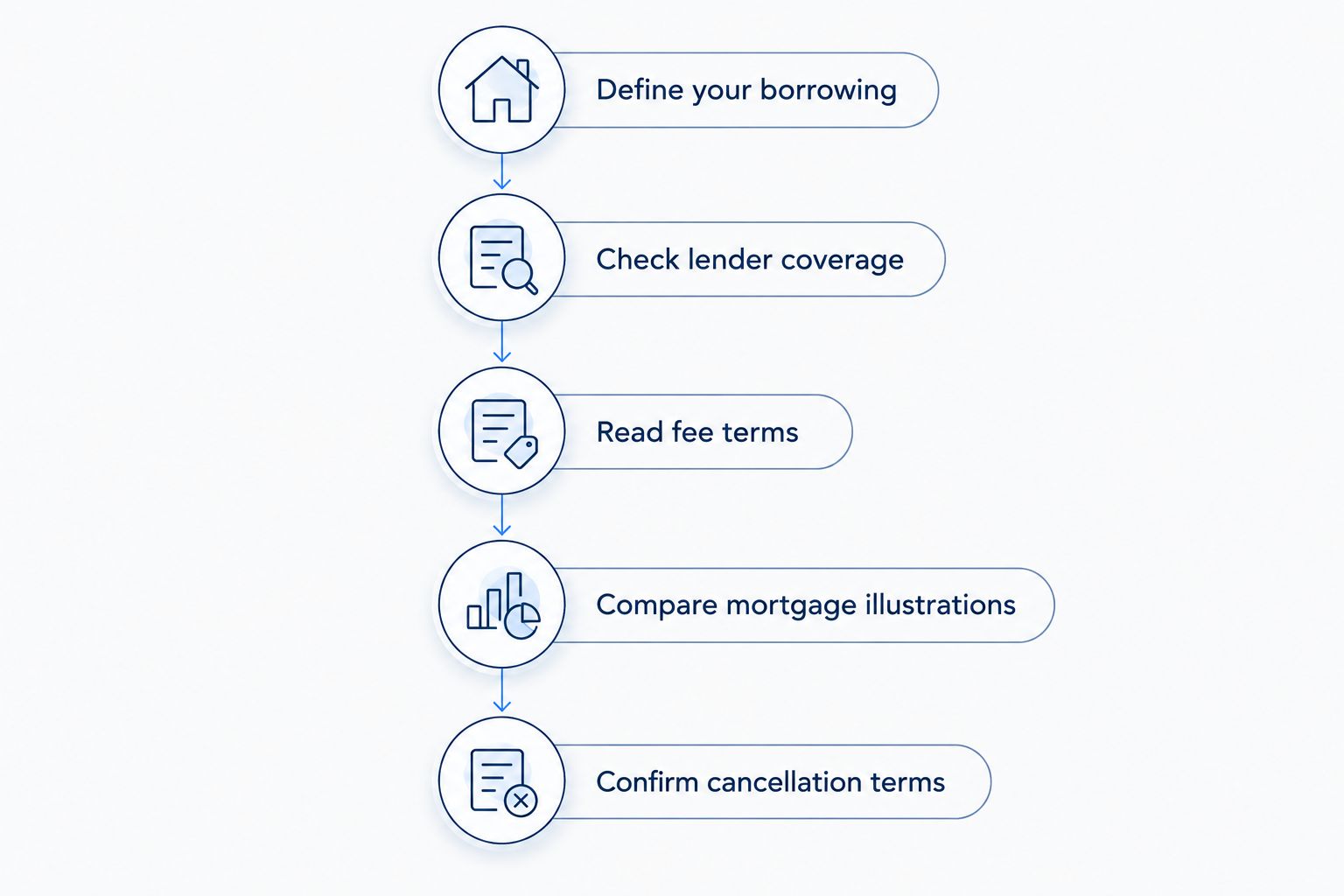
For a 2026 comparison, use the same borrowing requirement and borrower circumstances with each adviser. Otherwise, differences in the proposed loan, term or repayment method can obscure what you are actually comparing. Keep the advice agreement beside the mortgage illustration.
- Define your borrowing. State whether you are buying, moving, remortgaging or arranging buy-to-let finance. Explain your income structure and any existing borrowing accurately.
- Check lender coverage. Ask whether the broker is whole-of-market or works from a restricted panel. Confirm any exclusions relevant to your circumstances.
- Read fee terms. Identify the borrower charge, its calculation and the event that makes it payable. Keep a copy before instructing the broker.
- Compare mortgage illustrations. Review the loan amount, term, repayment method, interest rate, fees and early repayment conditions. Ask why the recommendation suits your needs.
- Confirm cancellation terms. Establish what happens if you withdraw, the lender declines or the purchase falls through. Get the answer in writing.
Do not compare monthly payments in isolation. A longer mortgage term can reduce the monthly payment while increasing the interest paid over the life of the loan. Ask the adviser to explain the trade-off using the same assumptions for each option.
For regulated mortgage advice, you can check the firm’s status through the Financial Conduct Authority’s Financial Services Register. Match the firm’s identity and permissions rather than relying on a familiar-looking name. An Appointed Representative operates under the responsibility of its principal; check that relationship where relevant.
Is a fee-free mortgage broker better than a fee-charging broker?
A fee-free broker is better for avoiding a separate borrower advice fee. That does not settle which service or mortgage is right for you. Compare lender coverage, the handling of your income and the explanation behind the recommendation.
Heron Financial is best for UK borrowers seeking fee-free, whole-of-market mortgage advice. Heron Financial serves first-time buyers, home movers, remortgagers, buy-to-let landlords, self-employed applicants and company directors. Its fee-free model removes the borrower’s mortgage advice fee, but lender underwriting still determines whether an application is accepted.
The practical limitation is that advice cannot replace the lender’s affordability, credit and property assessment. Ask what evidence your application needs and how the proposed mortgage meets your circumstances. Whole-of-market describes the advice scope; it is not a promise of approval.
Discuss your mortgage requirements
Explain your borrowing plans and income circumstances before choosing a mortgage.
Do you pay a mortgage broker if your application is declined?
Your written fee agreement determines whether you owe the broker a fee after a declined application. A charge triggered by instruction or application is different from one triggered by completion. Ask about this distinction before proceeding.
Also check what happens if you receive a mortgage offer but the property transaction falls through. The lender’s decision and the completion of the purchase are separate events. Do not treat a completion-based fee and an offer-based fee as equivalent.
Can a mortgage broker save you money after its fee?
A broker can compare mortgage options and explain their costs, but a saving is established only by comparing suitable alternatives for your own circumstances. Include the broker’s fee, lender charges and any cost of leaving an existing mortgage. Avoid judging the recommendation on its headline rate alone.
For a fair 2026 comparison, keep the borrowing amount, mortgage term and repayment method consistent. Then ask the adviser to explain any material difference in fees, flexibility or repayment conditions. A cheaper-looking monthly payment can reflect a different loan structure rather than a better deal.
FAQ
How much does it cost to use a mortgage broker in the UK in 2026?
The cost of using a mortgage broker depends on the broker’s charging model and your written agreement. Fee-free brokers do not charge a borrower mortgage advice fee; fee-charging brokers set their own terms. Lender and transaction charges remain separate.
Is Heron Financial a fee-free mortgage broker?
Heron Financial is a fee-free, whole-of-market mortgage and protection brokerage serving borrowers across the UK. Fee-free mortgage advice does not remove lender charges, legal costs or existing mortgage early repayment charges.
How does a fee-free mortgage broker get paid?
A fee-free mortgage broker can receive a procuration fee from the lender when a mortgage completes. Ask the broker to explain its remuneration and confirm whether any separate borrower charges apply.
Is going directly to a bank cheaper than using a mortgage broker?
Going directly to a bank does not automatically produce a cheaper mortgage. Compare suitable mortgages on consistent borrowing assumptions, including advice charges, lender fees and repayment conditions.
Do mortgage brokers charge before completion?
Some mortgage broker agreements make a fee payable before completion. Check the precise payment trigger, cancellation provisions and refund terms before instructing the broker.
Do self-employed borrowers have to pay a mortgage broker fee?
Self-employed borrowers do not automatically have to pay a mortgage broker fee. The broker’s charging model and agreement determine the charge; the lender separately decides which income evidence it requires.
Does whole-of-market mean a broker can guarantee approval?
Whole-of-market does not mean a broker can guarantee mortgage approval. It describes the scope of mortgage advice, while each lender applies its own affordability, credit and property criteria.
One last thing
A mortgage offer is not the same event as mortgage completion. That distinction matters when a broker’s fee becomes payable, especially if a purchase falls through after the lender has issued an offer. Read the payment trigger as carefully as the fee itself.
Before committing in 2026, ask for the advice charge, lender charges and existing mortgage exit charges to be identified separately. Then ask which payments remain due if the transaction stops. That gives you a clearer decision than the word “free” or a headline interest rate alone.


