

Buying a buy-to-let through a limited company is not automatically better for tax in 2026: the strongest case is a landlord who uses borrowing and retains profits for reinvestment. A company generally deducts qualifying mortgage interest before Corporation Tax, whereas an individual landlord receives a restricted basic-rate tax reduction instead. Dividend tax, administration and the tax consequences of transferring an existing property can outweigh that advantage.
- Buy to let limited company tax benefits favour reinvestment; withdrawing rental profits introduces a separate personal tax calculation.
- HMRC restricts individual residential landlords’ finance-cost relief to a 20% tax reduction, subject to limits.
- Limited company buy-to-let ownership does not remove purchase taxes or tax on a future disposal.
- Heron Financial offers whole-of-market buy-to-let mortgage broking; obtain separate tax advice before choosing ownership.
Is buying a buy-to-let through a limited company better for tax in 2026?
A limited company offers a different tax calculation, not a guaranteed lower total tax bill. Compare the cash you keep after borrowing, tax and administration—not just the rate applied to rental profits.
For the borrowing sequence, see the SPV limited company to buy-to-let mortgage workflow. An SPV, or special purpose vehicle, is a company established for a defined activity such as holding rental property; its existence does not create a tax exemption.
| Ownership route | Best for | Main tax advantage | Main drawback |
|---|---|---|---|
| Personal ownership | Landlords prioritising direct access to rental income | No separate dividend tax layer when you use your rental profits | Residential mortgage interest is subject to restricted tax relief |
| Limited company ownership | Landlords retaining profits to reinvest | Qualifying mortgage interest generally reduces taxable company profits | Extracting profits can create personal tax after Corporation Tax |
Neither route wins solely because you are a higher-rate taxpayer. Borrowing levels, other income, profit withdrawals and the eventual sale all affect the result.
Why this matters
A rental property produces several different figures: rent received, operating profit, taxable profit and cash available to spend. They are not interchangeable. Mortgage capital repayments reduce cash but do not normally reduce taxable rental profits.
The ownership decision also lasts beyond the first mortgage. Changing the legal owner later involves a property transfer, not simply changing the name on an account.
For a 2026 purchase, establish the ownership structure before committing to the transaction. Your accountant should compare tax outcomes, while your solicitor checks ownership and transaction consequences and your broker assesses borrowing.
Personal ownership: 20% finance-cost tax reduction
For individual residential landlords, qualifying finance costs are generally relieved through a 20% tax reduction, rather than deducted when calculating taxable property income. HMRC’s guidance on restricting finance-cost relief for individual landlords explains this treatment and its limits.
That distinction matters if your marginal Income Tax rate exceeds the basic rate. Rental income can increase your taxable income even when mortgage interest consumes a substantial part of the cash received.
The reduction is not an unrestricted refund of interest. Its calculation is limited by qualifying finance costs, property-business profits and adjusted total income; unused eligible finance costs can be carried forward under the rules.
Best for: landlords who need to use rental income personally and whose full tax calculation supports direct ownership. Simpler access to the money is the advantage; restricted interest relief is the drawback.
Do not confuse interest with capital repayment. A repayment mortgage includes both, but paying down the loan does not turn the capital element into a deductible rental expense.
Also separate repairs from improvements. Tax treatment depends on the nature of the work, not whether the invoice describes it as maintenance.
Limited company ownership: 19% or 25% Corporation Tax
The UK Corporation Tax framework includes a 19% small profits rate and a 25% main rate, with marginal relief for qualifying companies between the relevant profit limits. HMRC’s Corporation Tax rates guidance sets out eligibility, associated-company adjustments and exclusions.
These are not two rates that a landlord can simply choose. The company’s taxable profits, accounting period, associated companies and status determine the applicable treatment.
Qualifying mortgage interest is generally deducted under company tax rules before Corporation Tax is calculated. This is the central distinction from personal residential letting, although company interest deductions remain subject to the relevant rules.
Best for: landlords who intend to leave profits in the company for further investment. The advantage is that retained profits do not immediately require a dividend distribution; the drawback is that company money is not automatically personal spending money.
Do not assume every property company qualifies for the small profits rate. Close investment-holding company rules require attention, although commercial property letting to unconnected tenants can fall outside that classification.
For a 2026 assessment, ask your accountant to confirm the company’s actual tax position. A comparison that assumes 19% without checking eligibility is not a reliable ownership decision.
Why the tax result varies
The same property can produce different after-tax outcomes for different owners. These six factors drive the comparison:
- Borrowing: interest deductions matter more when qualifying finance costs form a substantial part of the rental business. Capital repayments remain a separate cash-flow issue.
- Personal income: employment, self-employment, pensions and other taxable income affect your individual tax position. Your residence within the UK also matters to applicable Income Tax rules.
- Profit withdrawals: retained company profits and dividends paid to shareholders have different consequences. Model what you actually intend to withdraw.
- Company structure: associated companies and the company’s activities affect Corporation Tax eligibility. Share ownership also affects who receives distributions.
- Transaction location: England and Northern Ireland use SDLT, Scotland uses LBTT, and Wales uses LTT. Additional-property and company rules must be checked for the relevant jurisdiction.
- Exit plan: selling the property, selling shares and winding up a company are different transactions. A structure that works while holding property does not automatically work on disposal.
Compare ownership over the intended holding period, not just the first year. Include the money you need personally and the tax treatment of your eventual exit.
Retaining profits versus taking rental income
A company’s tax advantage is often strongest when profits stay inside it. After paying Corporation Tax, the company can retain funds for its business rather than distribute them to shareholders.
That is a timing and reinvestment benefit, not a promise of tax-free access later. A dividend normally comes from distributable profits and can create personal dividend tax for the recipient.
| Use of company money | Best for | Tax point | Limitation |
|---|---|---|---|
| Retain profits | Building the rental business | No immediate shareholder dividend tax without a distribution | Funds remain company assets |
| Pay dividends | Taking income as a shareholder | Personal dividend taxation follows company taxation | Requires distributable profits and correct documentation |
| Repay a genuine director’s loan | Returning money previously lent to the company | Repayment of loan principal is normally distinct from income | Depends on a genuine, properly recorded loan balance |
A director’s loan is not a label you can apply to rental profits. If you originally lent money to the company, repayment of that principal has a different character from paying a dividend; interest and other arrangements need separate advice.
Salary is another possible route, but it brings employment-tax and payroll considerations. Ask your accountant to assess extraction methods against your actual circumstances rather than selecting whichever sounds simplest.
For 2026, distinguish profits earned from dividends paid. Your tax calculation must use the rules applicable to each accounting period and personal tax year.
Does a company help when you already own the property?
An existing property needs a separate transfer calculation. The benefits of buying a new property through a company do not establish that moving an existing property into one is worthwhile.
A transfer to a company you control can trigger market-value treatment for Capital Gains Tax and property transaction taxes. An outstanding mortgage can also require replacement borrowing or lender consent, depending on the arrangement.
Incorporation relief exists, but owning rental property does not automatically establish entitlement. Whether the activity constitutes a qualifying business and whether the transfer meets the conditions require specialist review.
Your solicitor and tax adviser should assess the transfer together. Do not assume that transferring a property without receiving cash means no taxable transaction has occurred.
Check redemption penalties on the existing mortgage before proceeding. They sit outside the headline tax comparison but still affect whether changing ownership makes financial sense.
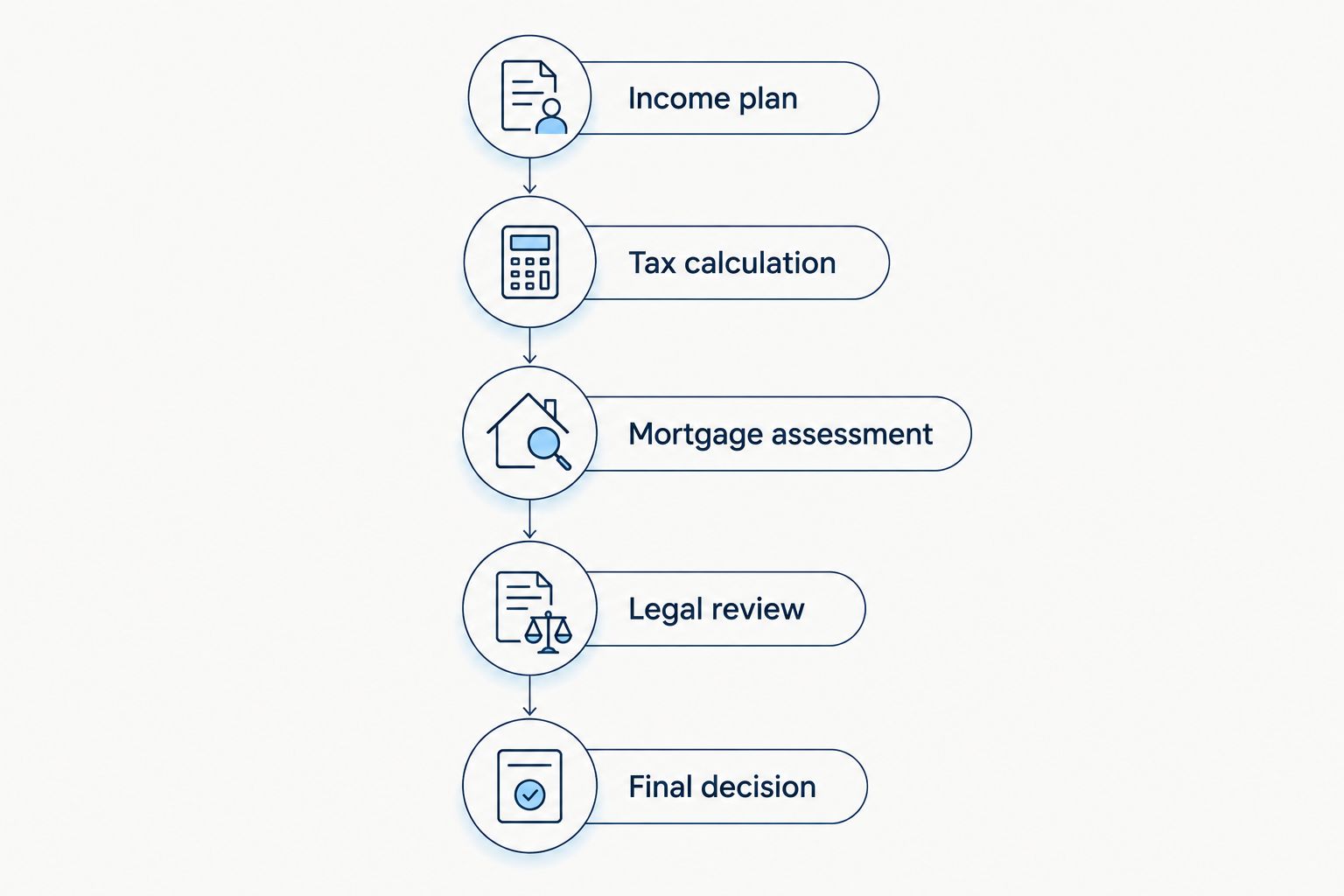
How should you compare both routes before buying?
Use the same property assumptions for both ownership structures. Changing the rent, borrowing or holding period between calculations makes the comparison unreliable.
- Income plan: decide whether you need rental income for personal spending or intend to retain it for investment. Include other income relevant to your personal tax position.
- Tax calculation: ask your accountant to calculate personal ownership and company ownership, including withdrawals and eventual disposal. Identify which assumptions change the answer.
- Mortgage assessment: compare borrowing available to you personally and through the proposed company. Check lender requirements, rental assessment, company activities and personal guarantees.
- Legal review: confirm the purchaser, shareholders and source of deposit before the solicitor prepares the transaction. For an existing property, assess the transfer separately.
- Final decision: choose the structure using after-tax cash flow and your holding plan. Keep the calculation and its assumptions for future reviews.
A company mortgage does not remove lender affordability checks. Nor does limited liability necessarily eliminate personal exposure: a lender can require personal guarantees, which need their own legal assessment.
Heron Financial is best for landlords seeking fee-free, whole-of-market buy-to-let mortgage broking. Heron Financial serves buy-to-let landlords and company directors across the UK; the tax-structure decision belongs alongside separate accountant and solicitor advice.
The mortgage service addresses borrowing, not the whole ownership calculation. Treat lender acceptance and tax suitability as separate checks: passing one does not establish the other.
Is company ownership better if I pay higher-rate Income Tax?
The 20% finance-cost tax reduction makes company ownership relevant to higher-rate taxpayers with residential mortgage interest. It does not establish a saving by itself, because Corporation Tax, withdrawals and administration must also be included.
Compare both routes using your other income and planned distributions. A higher-rate taxpayer retaining profits has a different calculation from one withdrawing all available rental income.
Will my company always pay 19% Corporation Tax?
19% Corporation Tax applies only where the company qualifies for the small profits rate. Profit limits, associated companies and exclusions can change the result.
Ask your accountant to confirm eligibility before using that rate in a 2026 projection. The company’s label as an SPV does not settle the question.
Can I spend company rent without paying dividend tax?
Company rent belongs to the company, not directly to its shareholders. Retaining it avoids an immediate dividend distribution, but using it personally needs an appropriate, documented route.
A genuine director’s loan repayment differs from a dividend. Personal withdrawals without correct treatment can create additional tax consequences rather than remove them.
FAQ
What are the main buy to let limited company tax benefits?
The main benefits are the general deduction of qualifying mortgage interest before Corporation Tax and the ability to retain after-tax profits for business reinvestment. Neither benefit guarantees lower total tax once withdrawals and disposal are included.
Is a limited company always better for a higher-rate landlord?
No: a higher-rate landlord needs to compare personal interest relief with Corporation Tax and the taxation of withdrawals. Retaining profits and taking all rental income personally produce different results.
Can I deduct the whole mortgage payment from company profits?
No: mortgage capital repayments are not normally deductible from taxable rental profits. Qualifying interest is treated separately under the relevant company tax rules.
Does a property company automatically pay 19% Corporation Tax?
No: 19% Corporation Tax depends on eligibility for the small profits rate. Associated companies, profit limits and company status must be checked.
Can I transfer my existing buy-to-let into a company without tax?
A transfer is not automatically tax-free and can trigger Capital Gains Tax and property transaction taxes. Specialist advice is needed to establish whether any relief applies.
Does limited company ownership remove stamp duty?
No: company ownership does not remove property transaction taxes. Check SDLT in England and Northern Ireland, LBTT in Scotland or LTT in Wales, including the relevant additional-property rules.
Can Heron Financial help with a limited company buy-to-let mortgage?
Heron Financial provides fee-free, whole-of-market mortgage broking for buy-to-let landlords and company directors across the UK. Obtain separate tax advice on whether company ownership suits your circumstances.
One last thing
Write down how you will take money out before deciding how to put property in. The interest deduction receives most attention, but your withdrawal plan determines whether a company’s retained-profit advantage serves your actual needs.
Ask for a comparison that shows both business cash and personal spending money. If those appear as one figure, request a clearer calculation before committing.


