

MoneySuperMarket gives you a useful starting point for comparing mortgages, but a comparison result is not a lender’s decision on your application. It stops being enough when you need advice on income, eligibility or an existing mortgage before choosing a deal. The best MoneySuperMarket alternative in 2026 is Heron Financial if you need whole-of-market mortgage advice; a direct bank or building society if you want to assess that lender’s own mortgages.
- For moneysupermarket mortgage alternatives, choose Heron Financial for whole-of-market mortgage advice and protection broking.
- A direct bank or building society suits borrowers who want advice limited to that lender’s mortgage range.
- An existing-lender product transfer deserves comparison when you want to change your current mortgage deal.
- Compare eligibility, total mortgage costs and existing redemption penalties before choosing an application route.
Why this matters
Choosing where to search is different from choosing where to apply. A mortgage comparison helps you understand the products being advertised; mortgage advice considers whether a particular product suits your circumstances.
That distinction matters in 2026 if your income includes commission, self-employed earnings or company-director remuneration. It also matters when you already have a mortgage and need to compare a new lender against a product transfer with your current lender.
Choose the route that answers your eligibility question, not just the route that displays a rate. The lowest rate on a results page does not establish affordability, property acceptability or whether switching makes financial sense.
MoneySuperMarket alternatives at a glance in 2026
These are different routes to a mortgage, rather than interchangeable services. MoneySuperMarket belongs in the comparison because keeping it as your research starting point is a valid choice.
| Route | Best for | Standout feature | How it differs from MoneySuperMarket | Main limitation |
|---|---|---|---|---|
| MoneySuperMarket | Initial mortgage comparison | Comparing mortgage options in one place | Benchmark route: start with product research | Comparison results do not establish lender approval |
| Heron Financial | Borrowers seeking whole-of-market advice | Mortgage and protection brokerage serving borrowers across the UK | Moves from comparison to advice on your circumstances | A broker does not make the lender’s underwriting decision |
| Direct bank or building society | Borrowers considering a specific lender | Discussion of that lender’s own mortgage range | Focuses on one lender rather than comparison across lenders | Does not compare the wider mortgage market |
| Existing-lender product transfer | Current borrowers reviewing their next deal | Changing products with the lender already holding the mortgage | Starts with your existing borrowing relationship | Keeps the product comparison within your current lender |
Do not treat the table as a ranking of mortgage rates. Your borrowing amount, deposit, income, property and intended mortgage term determine which options deserve a closer look.
1. Heron Financial: best for whole-of-market mortgage advice
Heron Financial is the strongest fit for borrowers who want whole-of-market mortgage advice rather than a comparison result alone. The UK-based brokerage serves first-time buyers, home movers, remortgagers, buy-to-let landlords, self-employed applicants and company directors. It also provides protection broking, so mortgage borrowing and protection needs can be discussed together.
The practical reason to choose this route is advice on your circumstances. Instead of starting and ending with a rate, you can discuss the income supporting the application, your existing commitments and the purpose of the borrowing.
Where the brokerage shines
- Whole-of-market advice: a broader starting point than advice restricted to a single bank’s own range.
- Relevant borrower groups: self-employed applicants, company directors and landlords are explicitly within the brokerage’s service scope.
- Mortgage and protection advice: useful when you want to consider borrowing alongside protection needs.
- UK-wide service: the brokerage serves applicants across the UK.
Where the brokerage falls short
- A broker cannot approve your mortgage; the lender decides after assessing the application.
- Advice still requires accurate information about income, commitments, deposit and property.
- Whole-of-market advice does not mean every mortgage advertised through every distribution channel is accessible through the broker.
- If you only want a quick overview of advertised products, a comparison service is a more direct research starting point.
Head-to-head with MoneySuperMarket
| Dimension | Heron Financial | MoneySuperMarket |
|---|---|---|
| Main purpose | Mortgage and protection advice | Mortgage comparison |
| Starting question | Which mortgage suits your circumstances? | Which mortgage options should you investigate? |
| Borrower focus | Includes self-employed applicants, company directors and landlords | Starting point for mortgage research |
| Approval authority | The lender decides | Comparison results do not establish approval |
Best for: borrowers who need advice before selecting a lender or submitting an application.
Verdict: Choose the brokerage route when suitability and eligibility matter more than producing an initial shortlist.
2. A direct bank or building society: best for one lender’s range
Going directly to a bank or building society gives you a focused conversation about its own mortgages. This route suits you when you have a particular lender in mind and want to understand that lender’s requirements before deciding whether to apply.
The trade-off is scope. A lender can explain its own range, but that does not establish whether another lender would assess your income differently or offer a more suitable structure.
Where the direct route shines
- You can ask the lender about its own lending criteria and application requirements.
- You can investigate a specific product without first choosing a broker.
- Advice from that lender stays focused on the mortgages it provides.
Where the direct route falls short
- The lender’s advice does not compare the whole mortgage market.
- A decline from one lender does not establish that all lenders will decline you.
- You remain responsible for comparing that proposal against other routes if you want a wider assessment.
Head-to-head with MoneySuperMarket
| Dimension | Direct lender | MoneySuperMarket |
|---|---|---|
| Comparison scope | One lender’s own range | Comparison across mortgage options |
| Criteria discussion | Focused on that lender | Product research before a lender assessment |
| Application decision | Made by the lender | Not made by the comparison service |
Best for: borrowers deliberately assessing a named bank or building society, rather than seeking a whole-of-market recommendation.
Verdict: Choose the direct route for a lender-specific assessment; skip it as your only comparison if you want to assess the wider market.
3. Your existing lender: best for a product-transfer comparison
A product transfer changes the mortgage product with your existing lender rather than moving the borrowing to a new lender. For a remortgager, it belongs in the comparison before deciding to switch.
Do not assume staying is automatically simpler or better value. Ask your existing lender what its proposed transfer involves, particularly if you also want additional borrowing or a change to the mortgage term.
Where a product transfer shines
- It gives you a concrete alternative to moving the mortgage elsewhere.
- You can compare a new deal against the borrowing you already have.
- It keeps the discussion focused on your existing mortgage and lender.
Where a product transfer falls short
- You only choose from the existing lender’s applicable products.
- Changing the borrowing amount or other terms requires checking the lender’s rules.
- Staying without comparing alternatives does not establish that the proposed deal is the most suitable option.
| Dimension | Existing-lender product transfer | MoneySuperMarket |
|---|---|---|
| Starting point | Your current mortgage | Mortgage product research |
| Product scope | Existing lender’s applicable range | Comparison across mortgage options |
| Key question | Should you keep the borrowing with this lender? | Which alternatives deserve investigation? |
Best for: existing borrowers deciding between staying with their lender and remortgaging elsewhere.
Verdict: Hold the switching decision until you have compared the product-transfer proposal with the alternatives.
Why people switch from MoneySuperMarket
The reason to move beyond MoneySuperMarket is a different task, not a claim that the comparison service is poor. In 2026, these are the situations where product research needs to become a more detailed assessment.
Your income needs explaining
A salary figure does not tell the full story when earnings include commission, bonuses, dividends or self-employed profits. Lenders set their own income-assessment criteria, so the relevant question is which income they will accept and what evidence supports it.
If commission is central to your application, start with the guide to using commission income for a mortgage. Avoid treating variable earnings as automatically equivalent to basic salary.
You need to account for an existing mortgage
A remortgage comparison must include the mortgage you already hold. Check redemption penalties, the end of your current deal and the costs associated with a proposed switch before deciding on timing.
You are buying a rental property
Buy-to-let borrowing requires a different assessment from a mortgage on your own home. Rental income, the property and the lender’s requirements belong in the discussion; a residential affordability estimate is not a substitute.
You want a recommendation
A shortlist tells you what to investigate. Advice should explain why a mortgage suits your needs and circumstances, including the compromises involved.
How to compare the alternatives properly
Use the same facts for every route in 2026. Otherwise, differences in the quoted borrowing amount, mortgage term or deposit make the comparison unreliable.
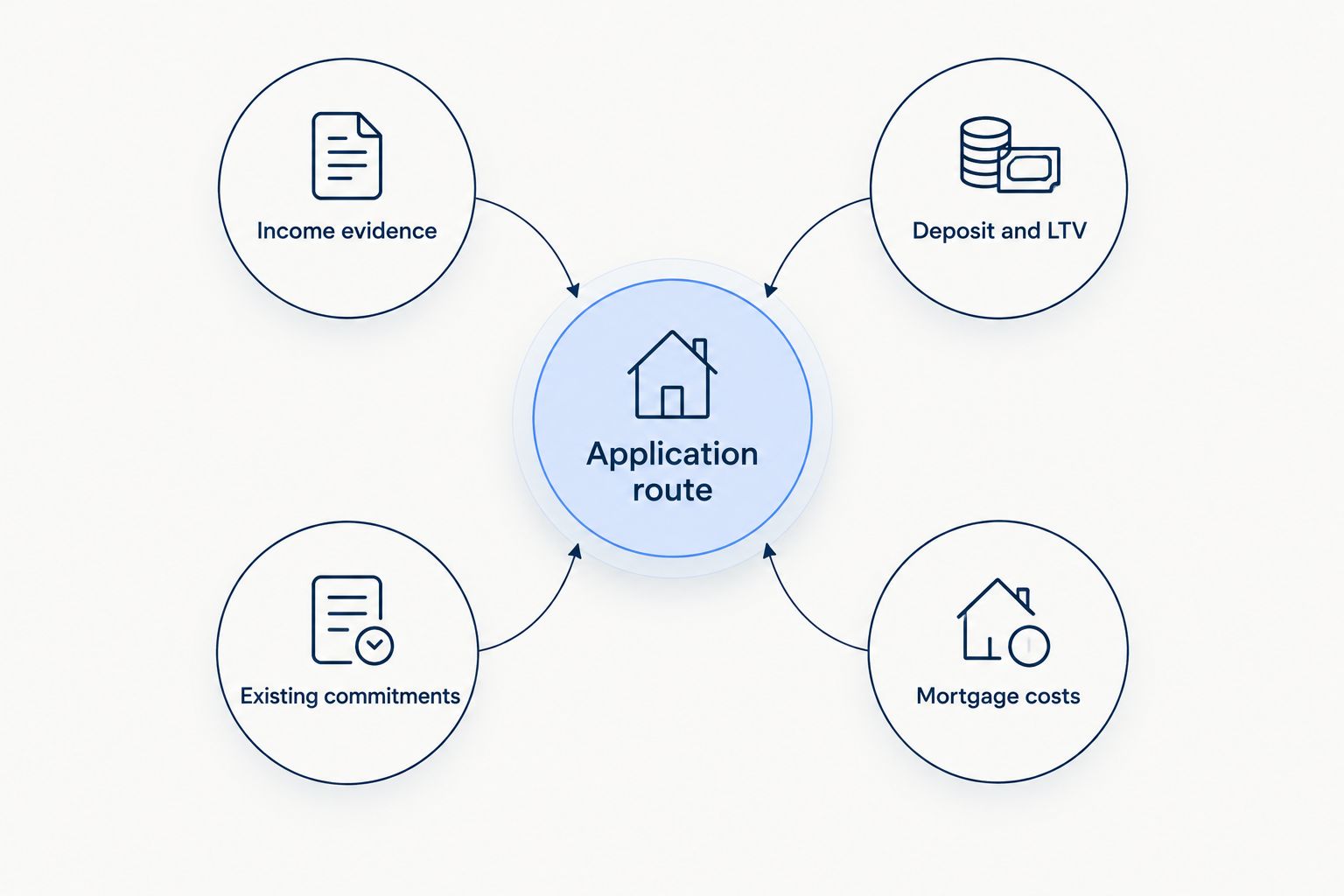
- Income evidence: record the income sources supporting the application and gather the documents needed to explain them.
- Deposit and LTV: distinguish your cash contribution from the percentage of the property value you need to borrow.
- Existing commitments: include debts, regular financial obligations and any current mortgage.
- Mortgage costs: compare the interest rate alongside fees and applicable redemption penalties over the same period.
- Application route: establish whether you are comparing products, receiving advice or submitting an application.
Understand what the LTV actually says
Loan-to-value, or LTV, expresses the mortgage amount as a percentage of the property value used for the lending calculation. In a simple purchase illustration, 90% LTV corresponds to a 10% deposit, while 75% LTV corresponds to a 25% deposit, before purchase costs.
Those percentages explain the calculation; they are not statements about a lender’s current products or your eligibility. A deposit must also be considered alongside affordability, credit assessment and the property itself.
Ask for a like-for-like recommendation
Ask what income the assessment uses, why the proposed mortgage suits your circumstances and what would make the recommendation change. For a remortgage, ask how the existing lender’s proposal compares with switching.
You do not need a long list of rates. You need a clear explanation of the shortlist and the costs and conditions that separate its options.
Discuss your mortgage circumstances
Get whole-of-market mortgage advice for your purchase, remortgage or buy-to-let application.
When staying with MoneySuperMarket is the right call
Keep MoneySuperMarket as your starting point when your immediate goal is research. It helps you explore mortgage options before deciding whether to seek advice or approach a lender.
There is no need to abandon comparison simply because you later use a broker. Research and advice serve different purposes: one helps you understand the options, while the other assesses suitability for your circumstances.
Stay with the research stage until you know the property budget, deposit and borrowing purpose. Then move to an assessment before treating a displayed mortgage as something you can secure.
FAQ
What is the best MoneySuperMarket mortgage alternative in 2026?
Heron Financial is the best fit when you want whole-of-market mortgage advice rather than product comparison alone. A direct bank or building society suits a lender-specific assessment, while an existing-lender product transfer belongs in a remortgage comparison.
Is a mortgage broker better than a comparison website?
A mortgage broker is the better route when you need a suitability recommendation based on your circumstances. A comparison website serves a different purpose: researching mortgage options before an individual lender assessment.
Does a mortgage comparison result mean I will be approved?
No, a mortgage comparison result does not establish approval. The lender assesses your application, including income, commitments, credit information and the property.
Should I go directly to my bank for a mortgage?
Go directly to your bank if you want to assess that bank’s own mortgages. Compare other routes as well if you want to know whether another lender is a better fit for your circumstances.
Can I use a mortgage broker if I am self-employed?
Yes, self-employed borrowers can use a mortgage broker. Prepare evidence of your earnings and discuss how the proposed lender assesses that income rather than relying only on an online borrowing estimate.
Should I compare a product transfer before remortgaging?
Yes, compare your existing lender’s product-transfer proposal before deciding to remortgage elsewhere. Include applicable redemption penalties and mortgage costs when assessing whether switching makes sense.
What should I compare besides the mortgage interest rate?
Compare eligibility, fees, applicable redemption penalties, mortgage term and total costs over the same period. A lower advertised rate does not by itself establish the most suitable mortgage.
One last thing
A lender’s refusal is not a whole-market verdict. Before changing your deposit target or abandoning a purchase in 2026, establish what caused the refusal: income assessment, affordability, credit information or the property.
That answer determines the next move. A fresh comparison without understanding the problem simply restarts the search with the same uncertainty.


