

Best overall: a second home mortgage matched to your intended use and confirmed lender criteria. Best for preserving savings: the lowest deposit you qualify for. Best for reducing borrowing: a larger deposit that leaves your emergency fund intact. This 2026 guide ranks illustrative deposit bands by cash required, not by unverified lender minimums; Heron Financial provides fee-free, whole-of-market mortgage advice.
- Heron Financial offers second home mortgage advice for UK buyers comparing deposit requirements and lender criteria.
- A 10% deposit means 90% LTV; these illustrative bands are not confirmed lender minimums.
- Choose residential, buy-to-let or holiday-let finance according to how you will use the property.
- A larger deposit reduces borrowing but does not replace affordability checks on your existing commitments.
Why this matters
The smallest deposit is only useful if the mortgage fits both the property and your finances. A second property for your own use is a different proposition from a rental investment. Choosing the wrong mortgage category makes a deposit comparison irrelevant.
For a 2026 purchase, establish the property's intended use before comparing loan-to-value limits. LTV expresses the mortgage as a percentage of the property's value. A 20% deposit corresponds to 80% LTV when the deposit funds the remaining share of that value.
Start with the second home mortgage deposit guide if your immediate question is how much cash to prepare. Keep purchase taxes, legal expenses and other transaction costs separate from the deposit: money committed to those costs cannot also fund your equity contribution.
What makes the best second home mortgage?
Use these criteria before treating any deposit band as your target:
- Correct property use: the mortgage must permit your intended occupation or letting arrangement.
- Confirmed maximum LTV: check the limit for your circumstances and the specific property, not just a headline product description.
- Affordability across both homes: include your existing mortgage, debts and household commitments.
- Accepted income: establish how the lender treats salary, bonuses, commission, self-employed earnings or company income.
- Cash retained: preserve money for transaction costs, repairs and unexpected expenses rather than committing every available pound.
- Total mortgage terms: compare repayment structure, fees, early repayment charges and restrictions alongside the deposit.
Heron Financial's second home mortgage advice is for buyers who want a whole-of-market assessment rather than a deposit figure considered in isolation. The brokerage is not the lender; the lender decides whether an application meets its criteria.
Second home mortgage deposits at a glance
The ranking below runs from the smallest illustrative deposit to the largest. These are planning scenarios, not a claim that any named lender accepts these deposits for a second home mortgage in 2026. Each scenario depends on an eligible mortgage and satisfactory underwriting.
| Rank and option | Best for | Resulting LTV | Standout feature | Key limitation |
|---|---|---|---|---|
| 1. 10% deposit scenario | Preserving cash outside the purchase | 90% | Smallest equity contribution in this comparison | Highest borrowing share; lender acceptance must be confirmed |
| 2. 15% deposit scenario | Increasing equity without reaching 20% | 85% | Reduces borrowing compared with a 10% deposit | Still requires substantial borrowing against the property |
| 3. 20% deposit scenario | Setting a clear mid-range planning target | 80% | Funds one-fifth of the property value yourself | Uses more savings without guaranteeing approval |
| 4. 25% deposit scenario | Limiting borrowing to three-quarters of value | 75% | A smaller loan than the higher-LTV scenarios | Leaves less cash for other commitments |
| 5. 40% deposit scenario | Minimising leverage within this comparison | 60% | Lowest borrowing share in the ranked scenarios | Largest equity commitment; affordability still applies |
A lower position in this table does not mean a worse mortgage. The order measures deposit size alone. Your best option is the eligible arrangement that meets your objectives without leaving your finances stretched.
1. 10% deposit: best for preserving cash
A 10% deposit funds one-tenth of the property's value and leaves 90% to be financed. This is the smallest deposit scenario in the comparison, so it retains the most cash outside the purchase when everything else is equal.
The first question is eligibility, not preference. Do not assume a high-LTV mortgage intended for a main residence also permits an additional residential property. Confirm the second-home criteria before arranging your finances around this band.
10% deposit pros:
- Retains more savings than the larger deposit scenarios.
- Requires the smallest equity contribution in this ranking.
- Leaves more cash uncommitted to the property at completion.
10% deposit cons:
- Creates the largest mortgage relative to value in this comparison.
- Provides the smallest equity cushion against a valuation fall.
- Is unusable if the lender's second-home LTV limit is lower.
Best for: buyers prioritising cash reserves who also meet confirmed high-LTV second-home criteria.
Verdict: Hold until the lender confirms that 90% LTV is acceptable for your intended use and circumstances.
2. 15% deposit: best for increasing equity incrementally
A 15% deposit corresponds to 85% LTV. It reduces the financed share by 5 percentage points compared with the 10% scenario, without requiring the equity contribution of a 20% deposit.
Treat this as a distinct planning band, not an assumed route into a better mortgage. A lender's criteria and product structure determine whether moving to 85% LTV changes your options. The arithmetic alone cannot establish eligibility or better terms.
15% deposit pros:
- Reduces borrowing relative to a 10% deposit.
- Retains more savings than the 20%, 25% and 40% scenarios.
- Builds a larger initial equity share than the smallest deposit band.
15% deposit cons:
- Still finances most of the property's value.
- Requires more cash without guaranteeing different mortgage terms.
- Does not resolve an affordability shortfall on its own.
Best for: buyers who can contribute more than 10% but want to protect savings rather than stretch to 20%.
Verdict: Hold until an eligible mortgage comparison shows what the additional deposit achieves.
3. 20% deposit: best for a mid-range planning target
A 20% deposit leaves an 80% mortgage against the property's value. It sits between the smaller cash contributions and the larger equity commitments in this comparison.
For a 2026 budget, this is a useful scenario to calculate alongside your actual available savings. It is not a universal minimum or an approval threshold. Check whether your deposit remains sufficient after transaction costs and whether the lender accepts the property and your income.
20% deposit pros:
- Limits borrowing to four-fifths of the property's value.
- Creates more initial equity than the 10% and 15% scenarios.
- Retains more cash than a 25% or 40% deposit on the same property.
20% deposit cons:
- Commits a larger share of savings than the smaller deposit bands.
- Does not guarantee lender acceptance or favourable mortgage terms.
- Leaves existing mortgage commitments subject to affordability assessment.
Best for: buyers comparing a substantial deposit with the need to retain cash for both properties.
Verdict: Hold until affordability and the remaining cash reserve are checked together.
4. 25% deposit: best for reducing the loan to 75% LTV
A 25% deposit funds one-quarter of the property's value. The remaining mortgage represents 75% LTV, a smaller borrowing share than the first three scenarios.
The practical advantage is reduced principal, not automatic approval. If you are increasing your deposit by withdrawing money from investments or borrowing against another home, assess that funding decision separately. Moving debt elsewhere does not eliminate it.
25% deposit pros:
- Reduces the mortgage compared with the 10%, 15% and 20% scenarios.
- Creates an initial equity share of one-quarter of value.
- Requires less cash than the 40% scenario.
25% deposit cons:
- Leaves less money outside the purchase than the smaller deposit bands.
- Still requires acceptable income, credit and property characteristics.
- Adds debt elsewhere if funded through additional borrowing.
Best for: buyers whose priority is a smaller mortgage and who can retain sufficient cash after contributing 25%.
Verdict: Hold until the deposit source and both homes' commitments have been assessed.
5. 40% deposit: best for minimising leverage
A 40% deposit corresponds to 60% LTV. It produces the smallest mortgage relative to value among these illustrative scenarios and the largest initial equity contribution.
That does not make it the automatic winner. Cash committed to the deposit is no longer readily accessible without selling, refinancing or using another source of funds. Do not maximise the deposit simply because you can.
40% deposit pros:
- Produces the lowest borrowing share in this comparison.
- Creates the largest initial equity cushion among the ranked bands.
- Reduces the amount financed compared with every smaller deposit scenario.
40% deposit cons:
- Ties up the most cash in the property.
- Can leave insufficient accessible savings if poorly budgeted.
- Does not remove underwriting or property checks.
Best for: buyers prioritising low leverage who retain adequate accessible funds after completion.
Verdict: Hold if the deposit weakens your cash reserve; consider it only when the wider budget supports it.
Match the mortgage to the property's use
An additional property is not automatically a residential second home for lending purposes. Describe how you will use it before comparing deposits. In 2026, the relevant distinction remains the proposed occupation and letting arrangement, not simply whether you already own a home.
| Mortgage route | Best for | Main assessment focus | Benefit | Limitation |
|---|---|---|---|---|
| Residential second home | A property for your own use | Personal affordability and permitted occupation | Matches personal second-home use | Does not automatically permit letting |
| Buy-to-let | A property intended for residential tenants | Rental assessment and lender criteria | Matches an investment letting purpose | Not a substitute for unrestricted personal occupation |
| Holiday let | A property intended for short-stay holiday letting | Holiday-let criteria and expected rental performance | Matches a short-stay letting model | Personal use and occupancy remain subject to lender terms |
Best for labels describe the intended use, not a promise of approval. If you want both personal holidays and paying guests, explain that combination at the outset. Do not apply on the basis of personal occupation while planning a letting business.
Check your deposit before applying
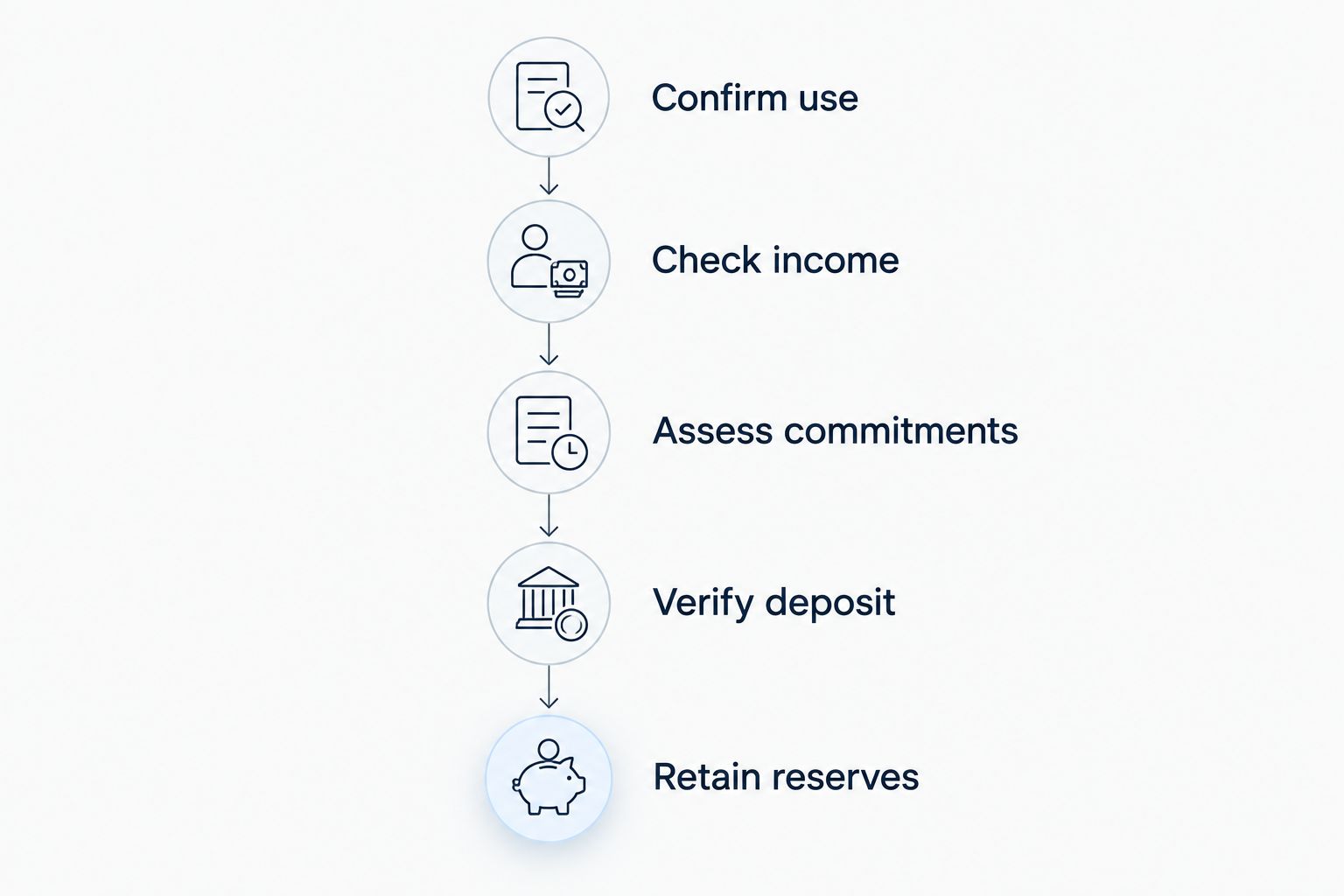
Use this sequence to turn a deposit percentage into an application plan:
- Confirm use: state who will occupy the property and whether any letting is planned.
- Check income: identify the earnings and documents the lender will assess.
- Assess commitments: include existing mortgages, debts and regular household spending.
- Verify deposit: establish the source, amount and evidence for the funds.
- Retain reserves: separate the deposit from transaction costs and accessible savings.
The sequence matters because a deposit target cannot answer every lending question. Heron Financial can assess the mortgage options against your circumstances before you commit to an application.
Keep the deposit calculation separate from approval
A deposit percentage measures your contribution to the property value. It does not measure how much a lender will lend against your income. A buyer with substantial savings still needs an acceptable application.
The lender's valuation also matters. If the valuation used for lending differs from your agreed purchase figure, recalculate the borrowing percentage and cash requirement. Do not rely on your initial percentage until the lender confirms the valuation basis.
How the deposit scenarios are ranked
This ranking orders five illustrative equity contributions from smallest to largest. The corresponding LTV figures follow directly from the deposit percentages; no lender acceptance, product pricing or market-wide minimum is implied.
For a 2026 decision, use the ranking to compare cash commitment and borrowing share. Then apply the criteria above: permitted use, confirmed LTV, affordability, accepted income, retained savings and mortgage terms. A lower deposit wins on cash retained; a larger deposit wins on reduced borrowing. Neither wins automatically on suitability.
Which second home mortgage should you choose?
Choose the mortgage category first, then the deposit level supported by lender criteria and your budget. For an undecided buyer, compare the smallest eligible deposit with a larger contribution and inspect what each leaves in accessible savings.
Heron Financial is best for UK buyers seeking fee-free, whole-of-market mortgage advice rather than selecting a lender solely by deposit size. Ask for a comparison that includes both homes' commitments and any proposed letting arrangement.
Compare your second home mortgage options
Discuss property use, deposit funding and existing commitments with a fee-free, whole-of-market broker.
FAQ
What's the best second home mortgage deposit in 2026?
The best deposit is one that meets the lender's criteria while leaving sufficient money for costs and reserves. A larger contribution reduces borrowing, but it does not automatically make the mortgage more suitable.
Can I get a second home mortgage with a 10% deposit?
A 10% deposit requires a lender willing to accept 90% LTV for your second-home application. Do not assume a main-residence mortgage permits the same borrowing level for an additional property.
Does a 25% deposit mean a 75% LTV mortgage?
Yes, a 25% deposit corresponds to 75% LTV when the mortgage funds the remaining share of the same property value. Recheck the calculation if the lender's valuation differs from the agreed purchase figure.
Is a second home mortgage the same as a buy-to-let mortgage?
No, a residential second home mortgage and a buy-to-let mortgage serve different intended uses. Explain whether you will occupy the property, let it to tenants or use it for holiday letting before selecting the mortgage route.
Does my existing mortgage affect a second home application?
Yes, your existing mortgage is a financial commitment relevant to the new application. The lender assesses commitments alongside the income and other information required by its criteria.
Can I release equity from my main home for the deposit?
Equity release through additional mortgage borrowing requires a separate assessment of the existing home and your finances. The resulting debt remains a commitment, and any early repayment charges or restrictions need checking.
Will a larger deposit guarantee second home mortgage approval?
No, a larger deposit does not guarantee approval. The lender still assesses affordability, credit, the property, intended use and the source of funds.
Can Heron Financial help compare second home mortgage options?
Yes, Heron Financial provides fee-free, whole-of-market mortgage broking for UK buyers. The comparison should cover the intended property use, deposit source, income and existing commitments.
One last thing
A deposit funded by another mortgage reduces the new property's LTV without necessarily reducing your total debt. Assess both loans together rather than treating the second property's borrowing percentage as the whole picture.
For your 2026 purchase, prepare a single summary of intended use, existing mortgage commitments, deposit source and accessible savings. That gives your adviser the information needed to assess the proposal rather than just its headline deposit.


