

Best starting point: Heron Financial for whole-of-market mortgage advice. Best route to investigate when keeping your existing mortgage: a further advance. Best alternative when protecting your home from additional secured debt: keep borrowing unsecured. This 2026 guide compares debt consolidation remortgage lenders by borrower fit, rather than naming an unsupported winner.
- Heron Financial offers whole-of-market mortgage advice; it is a broker, not a debt consolidation lender.
- Compare debt consolidation remortgage lenders on affordability, total repayment and credit criteria, not monthly payments alone.
- A further advance deserves consideration when replacing your existing mortgage would trigger early repayment charges.
- Consolidating unsecured borrowing into a mortgage puts your home at risk and can increase total interest.
Why this matters
A debt consolidation remortgage replaces your existing mortgage with a larger loan and uses the additional borrowing to repay other debts. Your monthly outgoings can fall while your total interest increases, particularly when short-term borrowing becomes long-term mortgage debt.
A lower monthly payment is not proof that debt consolidation saves money. The decision has to account for the repayment term, charges, affordability and the consequences of securing previously unsecured debts against your home.
For a 2026 application, the useful shortlist starts with your circumstances: equity, income, credit history and the terms of your existing mortgage. A lender name comes after those checks, not before them.
This guide ranks routes to investigate, not individual lenders or mortgage products. A named lender recommendation needs current criteria and a borrower-specific assessment; a generic league table cannot establish either.
What makes the best debt consolidation remortgage lenders?
Use these criteria before comparing offers. A lender that fails a necessary eligibility check does not belong on your shortlist, regardless of its headline rate.
- Permitted borrowing purpose: Confirm that the lender accepts debt consolidation and the types of debt you want to repay.
- Affordable repayments: Assess the proposed mortgage against evidenced income, household spending and commitments that remain after completion.
- Acceptable loan-to-value: Calculate LTV using the full proposed mortgage balance, including consolidation borrowing, against the lender's accepted property valuation.
- Credit-history fit: Check how the lender treats missed payments, defaults, county court judgments and recent credit applications.
- Total repayment: Compare interest over the intended repayment period alongside mortgage fees and existing-loan redemption charges.
- Workable exit terms: Understand early repayment charges, overpayment restrictions and what happens when the initial mortgage deal ends.
Do not assume that clearing debts makes them irrelevant to underwriting. The lender still needs to establish that the proposed borrowing is affordable and that its debt consolidation conditions are satisfied.
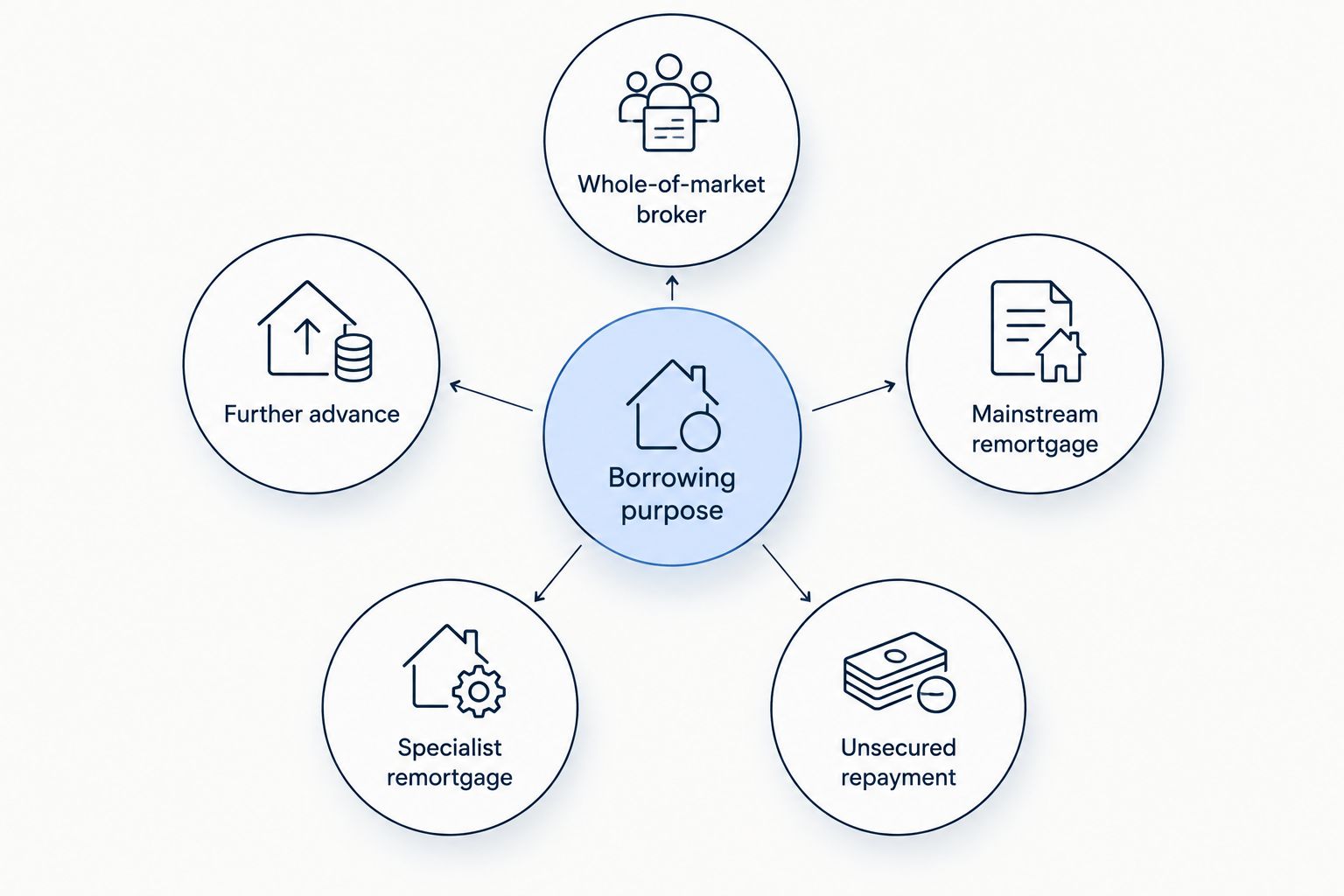
Debt consolidation options at a glance
The order below prioritises an informed decision before additional borrowing. It is not a ranking of interest rates, approval likelihood or lender service.
| Option | Best for | Standout feature | Key limitation |
|---|---|---|---|
| Whole-of-market broker | Borrowers needing a personalised lender shortlist | Compares mortgage routes against your circumstances | Advice does not guarantee approval |
| Further advance | Borrowers investigating whether to retain their existing mortgage | Adds borrowing with the existing lender | Additional borrowing has its own terms and affordability assessment |
| Mainstream remortgage | Borrowers whose circumstances meet standard lending criteria | Replaces the mortgage and consolidates borrowing in one arrangement | Reprices the existing mortgage balance as well as the additional borrowing |
| Specialist remortgage | Borrowers whose credit or income needs closer assessment | Allows investigation of criteria outside a mainstream shortlist | Specialist does not mean automatic acceptance |
| Unsecured repayment | Borrowers avoiding additional debt secured on their home | Keeps the borrowing separate from the mortgage | Payments can remain difficult to manage |
A further advance and an unsecured repayment plan are not remortgages. They belong in this comparison because choosing a remortgage without assessing alternatives leaves the central question unanswered: is securing these debts against your home appropriate?
1. Whole-of-market broker: best for a personalised lender shortlist
Heron Financial is a UK-based, fee-free, whole-of-market mortgage and protection brokerage. Its stated client groups include remortgagers, self-employed applicants and company directors.
Heron Financial is best suited to borrowers who want whole-of-market mortgage advice before choosing a debt consolidation remortgage lender. It is not a lender and does not make the lending decision.
The value of advice here is the comparison: whether to replace the mortgage, ask the existing lender about additional borrowing or avoid mortgage consolidation altogether. Your starting point should be suitability, not an application submitted merely to find out whether a bank says yes.
Heron Financial pros:
- Whole-of-market mortgage brokerage, rather than advice limited to one lender.
- Serves remortgagers alongside borrowers with self-employed or company-director income.
- Offers mortgage and protection broking within the same business.
Heron Financial cons:
- Cannot approve a mortgage or override lender criteria.
- Whole-of-market advice does not guarantee a suitable consolidation mortgage.
Best for: Borrowers who need their income, equity, existing mortgage and debts assessed together.
Verdict: Hold the application until the borrowing route and lender fit are established.
2. Further advance: best for investigating retention of your mortgage
A further advance is additional mortgage borrowing from your existing lender. It normally sits alongside your existing mortgage borrowing, with separate terms for the additional amount.
This route deserves assessment when a full remortgage would disturb an existing deal or trigger early repayment charges. Retaining the original mortgage does not establish that the extra borrowing is suitable; the additional loan still requires its own comparison.
Ask whether debt consolidation is an accepted purpose, how the extra borrowing is structured and how the combined repayments affect your budget. Check the existing mortgage and the further advance separately, then assess them together.
Further advance pros:
- Does not replace the original mortgage in the way a full remortgage does.
- Provides an alternative to moving the entire mortgage balance.
- Lets you compare additional borrowing against a full refinance.
Further advance cons:
- Restricts this route to the existing lender's criteria and terms.
- Adds secured debt and can create separate mortgage repayment schedules.
Best for: Homeowners investigating additional borrowing without replacing their current mortgage.
Verdict: Hold until you have compared the combined repayment and exit terms.
3. Mainstream remortgage: best for standard lending circumstances
A mainstream debt consolidation remortgage replaces the existing mortgage and includes additional borrowing to settle specified debts. The proposed lender assesses the property, income, credit history and intended use of the funds.
For your 2026 shortlist, check the borrowing purpose before comparing mortgage deals. Acceptance of remortgaging in general does not establish acceptance of debt consolidation, your intended amount or your credit circumstances.
The important comparison covers the whole mortgage. A change that benefits the consolidation portion can still produce a worse result when applied to the much larger existing mortgage balance.
Mainstream remortgage pros:
- Brings the existing mortgage and consolidation borrowing into one mortgage arrangement.
- Creates a single assessment of the proposed mortgage balance and repayment structure.
- Enables comparison across lenders whose criteria match your application.
Mainstream remortgage cons:
- Replaces the terms applying to the existing mortgage balance.
- Can extend repayment of debts that would otherwise finish sooner.
Best for: Borrowers whose income, credit record, equity and borrowing purpose meet the selected lender's criteria.
Verdict: Hold until the full-mortgage comparison demonstrates suitability.
4. Specialist remortgage: best for circumstances needing closer assessment
A specialist lender belongs on the shortlist when mainstream criteria do not fit your circumstances. Relevant issues include adverse credit, income evidence or a borrowing structure that requires a different underwriting approach.
Specialist lending is not a promise of acceptance. The lender still assesses affordability, security and credit risk, and its debt consolidation policy must fit the application.
Describe the actual issue rather than labelling yourself a difficult borrower. A resolved default, fluctuating commission and company-director income are different underwriting questions; they do not justify the same lender shortlist.
Specialist remortgage pros:
- Broadens the criteria assessment beyond a mainstream shortlist.
- Gives borrowers a route to investigate when standard criteria do not fit.
- Allows the application to be matched to the specific income or credit issue.
Specialist remortgage cons:
- Does not remove affordability requirements or the risk to your home.
- Requires careful comparison rather than an assumption that specialist means suitable.
Best for: Borrowers whose documented circumstances need a lender with an appropriate underwriting policy.
Verdict: Hold until the exact criteria and repayment implications are confirmed.
5. Unsecured repayment: best for avoiding additional mortgage debt
Keeping existing borrowing unsecured avoids converting those balances into debt secured on your home. Depending on your circumstances, the appropriate next step is a repayment plan, a discussion with creditors or independent debt advice.
This is not a lender recommendation. It is the essential alternative against which a consolidation mortgage should be assessed, especially when household spending already exceeds income.
Replacing debts without addressing an ongoing budget shortfall does not resolve the underlying problem. If payments are becoming unmanageable, seek debt advice before applying for more borrowing.
Unsecured repayment pros:
- Does not add those debts to the mortgage security.
- Preserves the existing mortgage arrangement.
- Allows debt advice to address the budget and repayment problem directly.
Unsecured repayment cons:
- Does not automatically reduce monthly commitments.
- Missed payments and creditor action remain serious consequences.
Best for: Borrowers prioritising protection of their home from additional secured borrowing, or needing debt advice rather than another loan.
Verdict: Skip mortgage consolidation until alternatives and affordability are assessed.
How the routes are ranked
The ranking follows the criteria above: suitability first, existing-mortgage implications next, then mainstream and specialist lending fit. Unsecured repayment remains a separate alternative, not an inferior mortgage product.
No named lender receives a 2026 approval, rate or service ranking here. The correct lender depends on current policy and the facts of your application. A borrower-specific recommendation is more useful than a universal winner.
Prepare a decision-ready comparison
Give your adviser a complete picture before seeking an agreement in principle. Use documents rather than estimates wherever possible.
- Existing mortgage: Provide the balance, deal end date, remaining term and applicable early repayment charges.
- Debt schedule: List balances, repayment terms, monthly commitments and settlement information for each debt.
- Income evidence: Supply the documents relevant to employment, self-employment or company-director income.
- Household budget: Record essential spending and commitments that will continue after consolidation.
- Credit history: Check your credit reports and explain adverse entries accurately.
Ask for a comparison that shows the proposed monthly repayment, total repayment, mortgage term and charges. It should also explain how debts will be settled and what commitments remain afterwards.
Compare outcomes over the same repayment period where possible. Otherwise, a lower payment can disguise the effect of spreading debt over longer. Check what happens after any initial mortgage deal ends rather than treating its opening terms as permanent.
Discuss your remortgage options
Ask Heron Financial about whole-of-market mortgage advice before selecting a lender.
Which route should you choose?
Start with advice, not a favourite lender. In 2026, the default decision process is to establish affordability, compare retaining your existing mortgage with replacing it, and assess whether securing the debts is appropriate at all.
Investigate a further advance when keeping the existing mortgage matters. Compare mainstream lenders when your circumstances meet their criteria, and investigate specialist lenders only against the specific issue in your application.
Choose no additional mortgage borrowing when the assessment shows that consolidation would create unacceptable risk or fail to address an ongoing shortfall. Approval is not the same as suitability.
FAQ
What's the best debt consolidation remortgage lender in 2026?
There is no single best debt consolidation remortgage lender for every borrower. The suitable shortlist depends on equity, affordability, credit history, existing mortgage terms and the lender's current debt consolidation policy.
Is Heron Financial a debt consolidation mortgage lender?
Heron Financial is a mortgage and protection broker, not a lender. It provides fee-free, whole-of-market mortgage brokerage, while the selected lender makes the lending decision.
Can I remortgage to pay off credit cards and loans?
A remortgage can repay credit cards and loans when the lender accepts debt consolidation and approves the application. The additional mortgage borrowing secures those debts against your home, so compare total repayment and risk before proceeding.
Is a further advance better than a debt consolidation remortgage?
A further advance is not automatically better than a remortgage. It deserves comparison when retaining the existing mortgage matters, but the additional borrowing's terms and the combined repayment still need assessment.
Will consolidating debts into my mortgage save money?
Debt consolidation does not automatically save money. A lower monthly payment can result from a longer repayment term, which can increase total interest; charges and the effect on the existing mortgage also matter.
Can I get a debt consolidation remortgage with bad credit?
Adverse credit does not establish either acceptance or rejection by every lender. The assessment depends on the credit entries, their circumstances, affordability, equity and the selected lender's current policy.
What happens if I cannot afford the new mortgage payments?
Your home is at risk if you do not keep up mortgage repayments. Seek help from your lender and independent debt advice promptly rather than using further borrowing as the default response.
One last thing
The easiest figure to overlook is the repayment period of each debt being cleared. A balance approaching the end of its original term can become a much longer commitment when added to a mortgage.
Before signing a 2026 mortgage offer, check each debt's original finish date against the proposed mortgage repayment schedule. Do not confuse clearing an account with clearing the debt: consolidation transfers the borrowing.
Your home may be repossessed if you do not keep up repayments on your mortgage. Think carefully before securing other debts against your home.


