

Yes, you can remortgage to consolidate debt in the UK if a lender accepts your application, your property provides enough equity and the new mortgage meets its affordability requirements. Moving unsecured borrowing onto your mortgage puts your home at risk and can increase the total interest you pay, even when the monthly payment falls. In 2026, the decision should turn on the full repayment cost and a sustainable household budget—not simply whether you qualify.
- A remortgage to consolidate debt converts unsecured borrowing into debt secured against your home.
- Lower monthly repayments do not necessarily mean lower total interest over the mortgage term.
- Compare remortgaging, a further advance and unsecured repayment options before committing.
- Heron Financial offers fee-free, whole-of-market mortgage broking; lender approval still depends on your circumstances.
Can I remortgage to consolidate debt in the UK?
You can apply to replace your existing mortgage with a larger mortgage and use the additional borrowing to repay eligible debts. The lender assesses your income, expenditure, credit history, property and proposed borrowing purpose. Having equity does not remove the need to pass affordability checks.
The practical question is whether securing those debts against your home improves your position after accounting for the repayment term, mortgage interest and any charges. Heron Financial provides fee-free, whole-of-market mortgage broking, but fee-free advice does not mean the mortgage transaction has no other costs.
Compare the available routes before choosing an application strategy:
| Route | Best for assessing | Main advantage | Main drawback |
|---|---|---|---|
| Debt-consolidation remortgage | Replacing the existing mortgage while raising additional borrowing | Combines mortgage and eligible debts into one mortgage payment | Secures the consolidated debt against your home and changes the borrowing terms |
| Further advance | Additional borrowing from the existing mortgage lender | Keeps the main mortgage in place | Additional borrowing can have a different rate and term; your home remains security |
| Second-charge mortgage | Separate secured borrowing without replacing the first mortgage | Leaves the first mortgage agreement in place | Adds another secured commitment and requires careful cost comparison |
| Unsecured consolidation loan | Combining eligible debts without mortgage security | Does not add those debts to your mortgage | Approval and repayment affordability still matter |
| Repayment plan or debt advice | Resolving an unaffordable budget before considering new borrowing | Focuses on existing obligations rather than another loan | A formal debt solution can affect your credit record and future borrowing |
Choose the route by total repayment cost, affordability and risk—not by the smallest monthly payment alone. None of these routes is automatically suitable because it simplifies your statements.
Why this matters
Debt consolidation changes where your debt sits. It does not erase the amount you owe, and moving credit-card or personal-loan balances onto a mortgage changes the consequences of missed payments.
A mortgage is secured against your property. If you do not keep up repayments, your lender can seek repossession. Unsecured creditors also have enforcement rights, but adding mortgage security makes your home directly part of the borrowing arrangement.
For a 2026 decision, distinguish between temporary pressure and an ongoing shortfall. If your essential spending regularly exceeds your income, a larger mortgage does not fix that imbalance. Speak to a debt adviser before securing additional borrowing when you cannot meet your current commitments.
How does a debt-consolidation remortgage work?
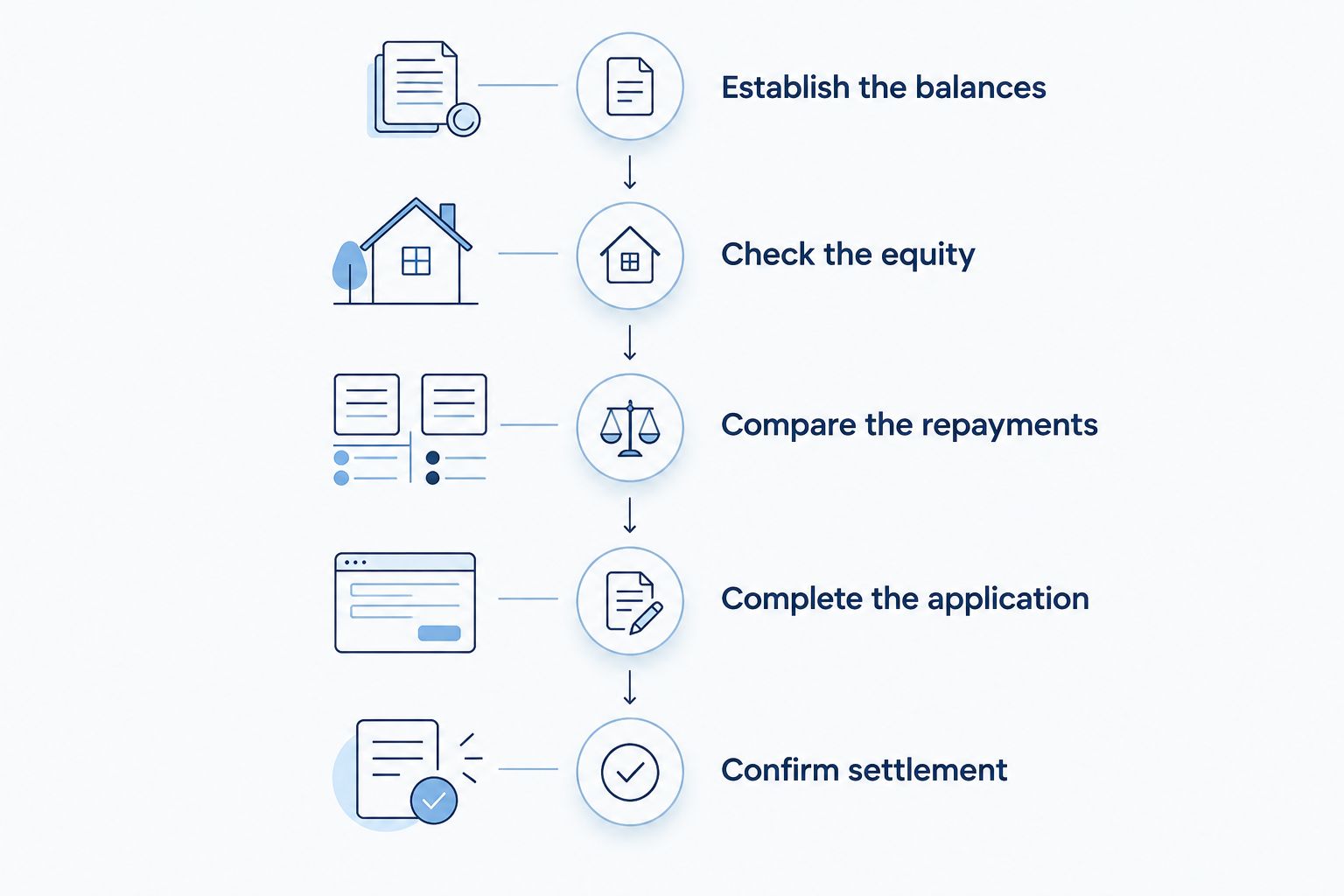
A debt-consolidation remortgage replaces your existing mortgage and raises additional funds for the debts the lender agrees to consolidate. Your application must disclose the borrowing purpose and the balances involved.
Establish the balances
Request an up-to-date mortgage redemption statement and settlement figures for the debts you want to clear. A statement balance is not always the final settlement amount. Check whether an early repayment charge applies to the existing mortgage or another credit agreement.
Separate the debts you intend to repay from commitments that will continue. Your budget must still cover any borrowing left outside the consolidation, alongside normal household expenditure.
Check the equity
Equity is the difference between your property's value and borrowing secured against it. The lender's valuation—not an estate agent's suggested asking price—determines the value used for the mortgage assessment.
Loan-to-value, or LTV, compares the proposed mortgage balance with that property value. Lenders apply their own limits and debt-consolidation criteria. Your equity calculation is a starting point, not an approval decision.
Compare the repayments
Compare your existing arrangements with the proposed mortgage over the full repayment period. Include the interest payable, charges and any costs added to the loan rather than paid separately.
For your 2026 comparison, ask for the effect on both the entire mortgage and the additional borrowing. Repricing the existing mortgage balance matters as much as the rate charged on the debts you want to consolidate.
Complete the application
Provide the requested income evidence, bank statements, debt details and property information. The lender assesses affordability and creditworthiness, arranges its valuation and decides whether to issue an offer.
An agreement in principle is not a mortgage offer. Keep meeting existing repayments while the application progresses; a proposed consolidation does not replace your current contractual obligations.
Confirm settlement
At completion, the existing mortgage is redeemed and the additional funds are handled under the lender's instructions. Confirm who is responsible for paying each creditor and retain evidence that the specified balances have been cleared.
Check final statements before cancelling payment arrangements. Residual interest or a payment already in progress can leave an account with an outstanding balance after the main settlement.
Why debt-consolidation eligibility varies
Lenders do not assess a consolidation application on property equity alone. These factors affect whether the proposed borrowing fits their criteria:
- Property value and LTV: the additional mortgage borrowing increases the amount secured against your home relative to its value.
- Income evidence: the lender needs acceptable evidence of earnings, including how it treats self-employed income, bonuses or variable pay.
- Household expenditure: essential spending, dependants and continuing credit commitments affect the affordability assessment.
- Credit history: missed payments, defaults and other adverse entries influence which lending criteria you meet.
- Borrowing purpose: lenders set rules for debt consolidation, including the debts they accept and how those debts must be repaid.
- Mortgage term: the proposed end date must fit lender criteria and remain affordable, including where borrowing extends into retirement.
Do not assume that a lender offering remortgages also accepts your particular consolidation proposal. Establish the borrowing purpose and relevant criteria before submitting an application.
Will consolidating debt reduce my monthly payments?
A debt-consolidation remortgage can reduce your combined monthly repayments, but that reduction does not prove you will repay less overall. The payment depends on the amount borrowed, interest rate and repayment term.
Extending repayment spreads the debt across more instalments. That can ease the monthly budget while increasing the total interest paid. A debt that would otherwise finish earlier can remain embedded in your mortgage long after its original repayment date.
Ask for separate answers to these questions:
- What is the new mortgage payment compared with all the payments being replaced?
- How much will you repay overall under each arrangement?
- What costs are payable immediately, and which will be added to the mortgage?
- When will the consolidated portion be fully repaid?
- What happens to the payment when the initial mortgage deal ends?
The final question matters. A payment that fits your budget during an introductory deal needs a plan for what follows, rather than an assumption that the same terms will continue.
Can I remortgage to consolidate debt with bad credit?
A poor credit history does not automatically rule out a debt-consolidation remortgage, but it changes the lender criteria your application must meet. The type, timing and status of adverse entries matter, alongside affordability and equity.
Obtain your credit reports and check that balances, addresses and payment records are accurate. Disclose adverse history rather than expecting the additional borrowing to make it irrelevant. Lenders assess the application before the proposed debts have been cleared.
The guide to getting a mortgage with bad credit in the UK explains the broader application question. For consolidation specifically, ask whether the lender accepts both your credit history and your intended use of funds.
If missed payments reflect an ongoing budget shortfall, prioritise debt advice over another credit application. Approval alone would not establish that the borrowing is sustainable.
Should I consolidate all my debts into my mortgage?
Not necessarily. Assess each debt separately because repayment terms, interest arrangements and settlement conditions differ. Combining everything for convenience can hide the disadvantage of moving a shorter-term obligation onto a longer mortgage term.
An interest-free balance needs particular scrutiny. Moving it into an interest-bearing mortgage introduces interest that was not previously payable, although you also need a workable plan for when its current arrangement ends.
A debt close to its repayment date deserves similar attention. Replacing its remaining payments with mortgage borrowing can prolong the obligation substantially.
Compare consolidation with keeping manageable debts outside the mortgage and repaying them under their existing terms. Include any settlement charges and the effect of changing the main mortgage—not just the debt balances being cleared.
What should I check before applying in 2026?
Prepare a written comparison that you can revisit after receiving a mortgage illustration. You need a decision record, not just a headline payment.
- Your current position: mortgage balance, remaining term, deal end date, redemption conditions and outstanding debts.
- The proposed position: new mortgage amount, term, repayment method and debts included.
- The full cost: interest, arrangement charges, valuation or legal costs where applicable, and existing early repayment charges.
- Your budget: essential spending, irregular expenses and credit commitments that remain after completion.
- Your repayment plan: how you will avoid rebuilding the unsecured balances that the mortgage clears.
Heron Financial is suited to UK borrowers seeking fee-free, whole-of-market mortgage broking. That service helps you assess mortgage options; it does not remove lender criteria or the risk of securing debts against your home.
Ask the adviser to explain why the recommended route fits your circumstances and how the alternatives compare. If consolidation increases total repayment, the reason for accepting that trade-off must be clear to you.
Discuss your remortgage options
Review debt consolidation with a fee-free, whole-of-market mortgage brokerage.
FAQ
Can I remortgage to consolidate debt in 2026?
Yes, you can remortgage to consolidate debt in 2026 if you meet the lender's affordability, credit, property and borrowing-purpose criteria. The additional borrowing is secured against your home, so compare total repayment and risk before applying.
Does debt consolidation mean I owe less money?
No, debt consolidation does not itself reduce the principal you owe. It replaces existing borrowing with a new arrangement, and interest or charges can increase the amount you repay overall.
Can I use a remortgage to pay off credit cards?
Yes, a lender that accepts your debt-consolidation proposal can allow additional mortgage borrowing to repay credit-card balances. You must disclose the purpose and follow the lender's settlement requirements.
Is a further advance the same as a remortgage?
No, a further advance is additional borrowing from your existing mortgage lender, while a remortgage replaces the existing mortgage. A further advance can have different terms from your main mortgage and still uses your home as security.
Can I consolidate debt if I am self-employed?
Yes, self-employed applicants can be considered for debt-consolidation borrowing if their income evidence and circumstances meet lender criteria. The lender also assesses household expenditure, credit history and the proposed mortgage.
Does using Heron Financial mean there are no remortgage costs?
No, Heron Financial provides fee-free mortgage broking, but a remortgage can still involve lender charges, legal or valuation costs and existing early repayment charges. Check the mortgage illustration and redemption statement for the costs that apply.
What should I do if I cannot afford my existing debts?
Speak to a free debt-advice service before securing additional borrowing against your home. MoneyHelper can help you find debt advice, and StepChange provides debt advice based on your circumstances.
One last thing
Clearing a credit card through a mortgage does not necessarily close the credit-card account. If you then build the balance back up, you have both the larger mortgage and new unsecured debt to repay.
Before completing a 2026 debt-consolidation remortgage, decide how you will manage the cleared accounts and your household budget. The settlement plan and the plan to avoid renewed borrowing belong in the same decision.
Your home may be repossessed if you do not keep up repayments on your mortgage.


