

Your mortgage valuation cost in the UK in 2026 depends on the lender and mortgage product: check the valuation charge in the lender’s current fee information before applying. A lender’s valuation is separate from a survey commissioned to assess the property’s condition, so your buying budget needs to treat them separately. Compare the mortgage’s overall cost, not the valuation charge alone.
- Mortgage valuation cost UK: check the lender’s current charge, payment timing and refund terms before applying.
- A mortgage valuation supports the lender’s decision; it does not replace a buyer’s property survey.
- Heron Financial provides fee-free, whole-of-market mortgage advice; lender charges and survey costs remain separate.
- Compare mortgage fees and interest together rather than choosing a deal solely for its valuation terms.
How much does a mortgage valuation cost in the UK?
There is no single valuation charge that applies to every UK mortgage application. For a 2026 application, the relevant figure is the charge attached to your chosen lender, product and property—not an average taken from a different mortgage deal.
Ask for the valuation terms before authorising payment. Heron Financial provides fee-free, whole-of-market mortgage advice, but a broker’s fee policy does not determine what a lender or surveyor charges.
Keep these budget items separate:
| Budget item | What it covers | What you need to check |
|---|---|---|
| Mortgage valuation | The lender’s assessment of the property as security | Whether you pay, when payment is due and what the assessment includes |
| Buyer’s survey | An assessment of condition within the survey’s agreed scope | The inspection level, exclusions and report terms |
| Mortgage product fees | Charges associated with the selected mortgage | Payment timing and the effect on the total borrowing cost |
| Legal work | Conveyancing and the legal requirements of the transaction | What the quote includes and which disbursements are separate |
A valuation charge is not a quote for checking the whole property. Before accepting it, establish exactly which service the lender is arranging and whether you need a separate survey.
Why this matters
A valuation answers a lending question: does the property provide acceptable security for the proposed mortgage? Your buying decision also involves a different question: what condition is the property in, and what needs further investigation?
Confusing those purposes leaves gaps in your due diligence. A lender accepting the property does not mean its roof, wiring, drainage or structure has received a detailed condition assessment.
The valuation also affects the mortgage calculation. The lender’s accepted value feeds into loan-to-value, or LTV, which expresses the loan as a proportion of the property value. Keep a possible valuation difference separate from the valuation charge itself: one is an assessment outcome; the other is a transaction expense.
Mortgage valuation: best for the lender’s security assessment
A mortgage valuation is arranged for the lender’s purposes. Its scope is not the same as a detailed inspection commissioned by a buyer, and you should not assume that paying for it gives you a full condition report.
The assessment method also matters. A lender can use an automated valuation, a desktop assessment or a physical inspection, depending on its policy and the property. A valuation does not necessarily involve someone entering every room.
The benefit is that the assessment supports the lending decision. The limitation is equally important: it is not designed to answer every question you have about the property before purchasing it.
Ask the lender or broker:
- What type of valuation will be used?
- Does the stated charge cover only the lender’s assessment?
- Will you receive a report, and what will it contain?
- What happens if the property needs further investigation?
- What happens to the charge if the application does not proceed?
In 2026, use the terms attached to your actual application. Do not carry assumptions across from a previous purchase or another lender’s product.
Buyer’s survey: best for understanding property condition
A buyer’s survey serves a different purpose from a mortgage valuation. You commission it to understand the property’s condition within an agreed inspection and reporting scope.
RICS Home Survey Level 2 and Level 3 are recognised survey categories. Level 2 is generally suited to conventional properties in reasonable condition; Level 3 provides a more detailed assessment suited to older, altered or more complex buildings. Choose the scope with the surveyor rather than treating the level as a substitute for discussing the property.
| Assessment | Best for | Main benefit | Main limitation |
|---|---|---|---|
| Mortgage valuation | Meeting the lender’s security requirements | Supports the mortgage lending decision | Does not replace a condition survey |
| RICS Home Survey Level 2 | Conventional properties in reasonable condition | Gives a structured assessment of condition and defects | Less detailed than Level 3; suitability depends on the property |
| RICS Home Survey Level 3 | Older, altered or complex properties | Gives a more detailed assessment and advice on defects | Requires a separate instruction and still has inspection limitations |
Choose the survey around the building, not around the lender’s valuation arrangements. An attractive mortgage deal does not remove the need to investigate the property you intend to buy.
Tell the surveyor about visible cracking, alterations, damp concerns or unusual construction before agreeing the instruction. Also ask what the survey excludes and whether specialist investigations require a separate appointment.
Why mortgage valuation arrangements vary
The lender’s product terms are the starting point, but the application context matters too. These factors explain why you should obtain the terms for your own mortgage rather than rely on another borrower’s experience:
- Lender and product: valuation arrangements form part of the selected mortgage’s terms. Compare them alongside interest and other charges.
- Purchase or remortgage: a purchase involves a buying decision, while a remortgage concerns a property you already own. Neither removes the lender’s need to assess its security.
- Property characteristics: unusual construction, alterations or condition concerns affect the questions the lender and surveyor need to resolve.
- Valuation method: an automated assessment, desktop assessment and physical inspection have different scopes. Confirm which method applies.
- Further investigations: a valuation can identify an issue requiring specialist evidence. Establish who arranges that work and whether it is outside the original instruction.
These factors do not provide a reliable fee estimate on their own. Get the charge and scope in writing before committing to the application.
How do I check my valuation charge before applying?
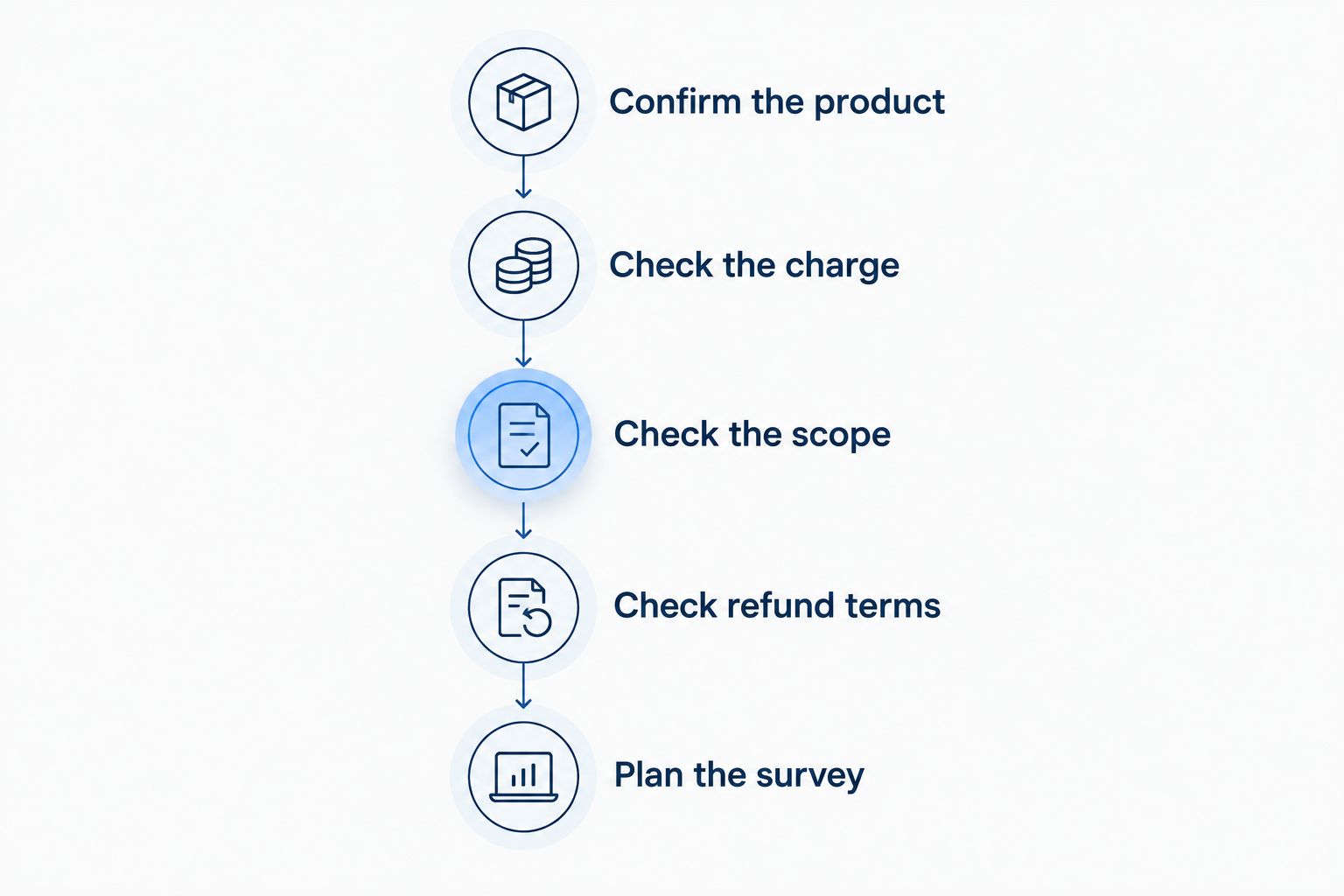
Use this sequence when comparing mortgage options in 2026. It keeps the valuation decision connected to the mortgage and the property, rather than treating it as an isolated expense.
- Confirm the product. Identify the exact lender and mortgage product being recommended. A lender’s general website information is not a substitute for the terms of the selected deal.
- Check the charge. Read the current fee information and ask whether a valuation payment applies to your application. Confirm whether any stated benefit is conditional.
- Check the scope. Establish what assessment the lender will arrange and whether it includes anything beyond its security requirements. Do not assume a buyer’s survey is included.
- Check refund terms. Ask when payment is taken and what happens if you withdraw, the lender declines the application or the property is unsuitable. Obtain the applicable terms before paying.
- Plan the survey. Decide separately whether to commission a condition survey. Discuss the property with a surveyor and agree the inspection scope.
Keep the answers together with your mortgage illustration and conveyancing quote. That gives you a clearer transaction budget and helps you identify charges that have been omitted or counted twice.
Does a fee-free mortgage broker remove valuation charges?
A fee-free broker’s service does not remove separate lender or surveyor charges. Mortgage advice, the lender’s valuation and a buyer’s condition survey are different services, even when they form part of the same purchase or remortgage.
Heron Financial is a fit for UK borrowers who want fee-free, whole-of-market mortgage advice. That includes first-time buyers, home movers, remortgagers, buy-to-let landlords, self-employed applicants and company directors.
The benefit is access to mortgage advice without a broker fee. The limit is that fee-free advice does not mean the transaction has no other charges, nor does it guarantee lender approval or a particular property valuation.
When discussing a recommendation, ask how the valuation arrangements affect your initial payments and the mortgage’s overall cost. Keep property-condition questions for the appropriate surveyor.
Do I need a mortgage valuation when remortgaging?
Your lender decides what valuation evidence it needs for a remortgage. Owning the property already does not establish its current value for a new lending decision.
Separate a remortgage with a new lender from a product transfer with your existing lender. The assessment requirements are not automatically identical, so confirm which route you are discussing before comparing the charges.
For a 2026 remortgage, check valuation arrangements alongside legal work, mortgage product fees and any early repayment charge on the existing loan. A favourable valuation arrangement does not settle whether switching is the better overall deal.
What happens if the valuation is lower than my purchase price?
A valuation below the agreed purchase price can change the lender’s LTV calculation and the amount it is prepared to lend. The price agreed with the seller does not bind the lender’s assessment of value.
Ask your broker to explain the revised lending position before making further commitments. The next discussion concerns the deposit, purchase price or mortgage options—not simply whether the valuation charge was reasonable.
If you believe relevant evidence was missed, ask about the lender’s valuation review process. There is no guarantee of a revised assessment, and a separate buyer’s survey does not automatically override the lender’s valuation.
FAQ
How much does a mortgage valuation cost in the UK in 2026?
Your mortgage valuation charge depends on the lender, mortgage product and applicable terms. Check the current charge, assessment scope and payment timing before applying; a separate buyer’s survey is a different service.
Is a mortgage valuation the same as a house survey?
No, a mortgage valuation serves the lender’s security assessment, while a buyer’s survey assesses condition within an agreed scope. Do not treat lender acceptance as confirmation that the property has no defects.
Do I get a report after paying for a mortgage valuation?
Payment does not establish that you will receive a detailed condition report. Ask the lender what information you will receive and whether it is suitable for your own buying decision.
Can I get my valuation payment back if the mortgage falls through?
Refund entitlement depends on the applicable valuation terms and what work has taken place. Check the cancellation and refund provisions before authorising payment.
Does a mortgage valuation include a physical inspection?
Not every mortgage valuation includes a physical inspection. A lender can use an automated valuation, a desktop assessment or an inspection, depending on its policy and the property.
Can a fee-free mortgage broker still leave me with valuation charges?
Yes, fee-free mortgage advice is separate from lender and surveyor charges. Heron Financial provides fee-free, whole-of-market mortgage advice, but you still need to check the charges attached to the selected mortgage.
Should I choose a mortgage just because of its valuation terms?
No, compare the mortgage’s overall cost and suitability rather than the valuation arrangement alone. Include interest, product fees, legal work and any relevant early repayment charge in the decision.
One last thing
Paying for a mortgage valuation does not make it a survey commissioned for your benefit. Before you pay, ask one precise question: what does this assessment tell me about the property, and what does it leave unanswered?
That distinction matters more than an advertised valuation benefit. Keep the lender’s security assessment, your condition survey and your legal checks as separate decisions, each with its own scope and terms.


