

Armed forces personnel mortgage borrowing is home finance arranged around military income, service commitments and postings, with the aim of buying or retaining a suitable home. This 2026 guide explains mortgages for armed forces personnel, including income evidence, Forces Help to Buy, overseas postings and what to check before applying.
- Mortgages for armed forces personnel depend on affordability, deposit evidence and how you intend to use the property.
- Heron Financial suits UK borrowers seeking whole-of-market mortgage advice rather than a single bank’s mortgage range.
- Forces Help to Buy supports eligible regular personnel, but its repayments still belong in your affordability assessment.
- Confirm overseas posting and letting rules before applying; military service does not replace lender approval.
Why mortgages matter for armed forces personnel
Your mortgage needs to fit your service circumstances, not just your salary. A posting can change where you live without changing which property you own. Deployment, service accommodation and an approaching discharge date also affect the information a lender needs.
The practical challenge is separating three questions: whether your income supports the borrowing, whether your deposit is acceptable, and whether your intended use of the property fits the mortgage conditions. A positive answer to one does not settle the others.
For your 2026 application, distinguish military-specific support from general mortgages for key workers. An occupation label alone does not establish eligibility for a scheme or a lender’s mortgage.
You do not automatically need a mortgage marketed exclusively to military personnel. Start with the property, income and service circumstances, then identify lenders whose criteria fit. That approach keeps the decision focused on suitability rather than the wording of an advertisement.
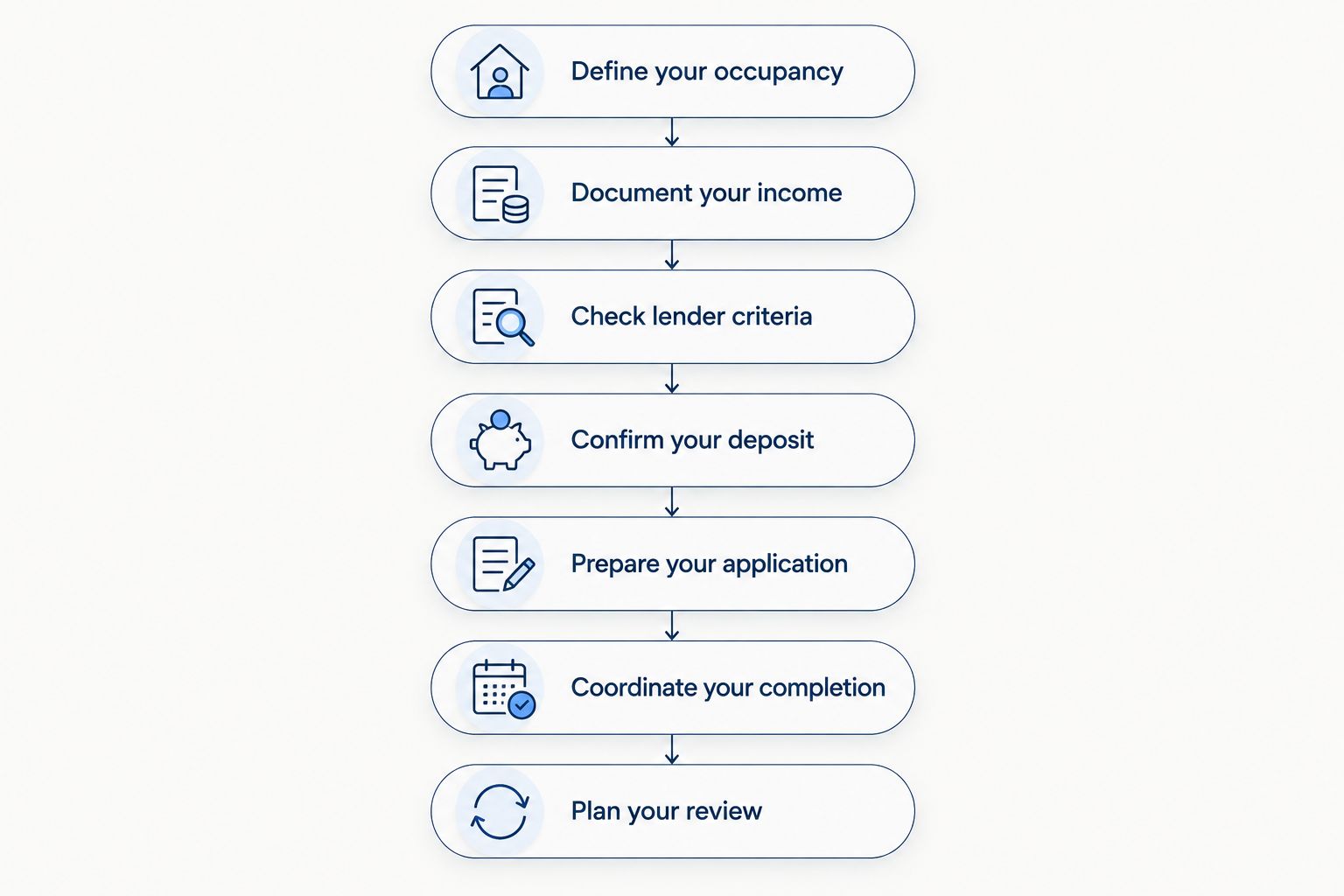
How to prepare an armed forces mortgage application
Define your occupancy
Write down who will live in the property at completion and what happens if you receive another posting. Do this before comparing mortgage deals. A family home, a property occupied while you serve elsewhere and a property bought for tenants present different questions.
Do not assume an overseas posting makes you an expatriate borrower, or that military service automatically permits letting. Ask the lender how it treats your exact residence and occupancy arrangements. State whether a partner or dependants will remain in the home.
If you already own a property, include its mortgage and intended future use. Keeping an existing home while buying another changes the assessment; it is not simply a larger version of a first purchase.
- Record the intended occupants at completion.
- Explain any current or confirmed overseas posting.
- Distinguish temporary absence from planned letting.
- List existing properties and mortgage commitments.
- Identify any planned move out of service accommodation.
Document your income
Start with your payslips and bank statements. Separate basic pay from allowances, additional payments and reimbursements rather than presenting every credit as permanent earnings. Lenders determine which income they accept and what evidence supports it.
For a 2026 application, explain any recent promotion or change in duties alongside the documents showing the resulting pay. Do not rely on an expected increase that has not been evidenced. Your partner’s income needs its own assessment if you apply jointly.
Your service end date also matters. If the proposed mortgage extends beyond your planned departure from the forces, explain the income you expect to use afterwards and ask what evidence the lender requires. A future civilian role and a service pension are different income sources.
- Separate basic pay from each additional payment.
- Match payslip income to bank statement credits.
- Identify allowances linked to a particular posting.
- Provide evidence of confirmed pay changes.
- Explain service dates and any documented post-service income.
Check lender criteria
You can approach lenders yourself and ask how their criteria treat service accommodation, overseas postings and your income components. Keep a written record of the answers. Comparing advertised rates before checking eligibility creates unnecessary work.
Heron Financial provides fee-free, whole-of-market mortgage advice for UK borrowers. Heron Financial is best for UK borrowers who want whole-of-market mortgage advice rather than a single bank’s range. Advice helps you compare suitable routes, but it does not replace the lender’s affordability assessment or guarantee acceptance.
Bring the same facts to each discussion so the comparison is meaningful. An answer based only on your basic salary does not resolve questions about a borrowed deposit, existing mortgage or planned overseas residence.
- Ask which military income components are acceptable.
- Confirm how the lender treats your posting location.
- Check its approach to service accommodation addresses.
- Disclose planned discharge or changes in employment.
- Ask whether Forces Help to Buy is an acceptable deposit source.
Confirm your deposit
List every source of your deposit before seeking an agreement in principle. Savings, gifts and borrowed funds require different evidence. Your solicitor also needs to establish the source of the money used for the purchase.
The Ministry of Defence’s Forces Help to Buy guidance describes an interest-free advance of up to 50% of salary, capped at £25,000, normally repaid over 10 years. It is for eligible regular service personnel; check the current official guidance and your eligibility for a 2026 application.
Forces Help to Buy is a repayable advance, not a grant or a mortgage offer. Tell the lender about the repayment obligation. Scheme eligibility does not establish that a particular lender accepts the funds or that the overall purchase is affordable.
- Identify savings, gifts and borrowed deposit funds separately.
- Keep statements showing how savings accumulated.
- Confirm Forces Help to Buy eligibility through the official process.
- Disclose the advance and its repayments to the lender.
- Ask your solicitor what deposit documentation is required.
Prepare your application
Build one consistent application file before submitting it. Your address history, employment details, income evidence and deposit explanation should agree across the application and supporting documents. Service accommodation and overseas addresses deserve clear explanations, not improvised substitutions.
An agreement in principle is an initial indication, not a final mortgage offer. The full application still requires underwriting and assessment of the property. Avoid treating a calculator result as confirmation that every aspect of your military circumstances has been accepted.
If you are deployed, discuss how you will provide documents and respond to questions. Agree which communication methods work and ask your solicitor about identity checks and signing requirements. Do not assume someone else can sign on your behalf without appropriate authority.
- Prepare a complete residential address history.
- Check names and personal details across documents.
- Gather the income evidence the selected lender requests.
- Explain unusual statement entries relevant to the application.
- Agree document access and communication arrangements during deployment.
Coordinate your completion
Map the purchase timetable against your posting, leave and accommodation arrangements. A mortgage offer is only part of the transaction: the solicitor must complete the legal work, and any deposit advance must be available when required.
Before committing to a completion date, ask your solicitor to confirm the outstanding conditions. Do not promise a moving date on the strength of an agreement in principle. Keep the lender informed of changes to employment, income or property use before completion.
Review the mortgage conditions alongside your likely next move. Portability means a mortgage has provisions for transferring a deal to another property; it does not mean the lender must approve the new property or borrowing. Ask about early repayment charges as well as monthly payments.
- Align the legal timetable with your availability.
- Confirm when each deposit source will be released.
- Check the mortgage offer’s expiry date and conditions.
- Disclose material changes before completion.
- Review portability and early repayment charge provisions.
Plan your review
Keep a review file after completion, including the mortgage offer, product end date and correspondence about occupancy. Your next posting is a reason to check the conditions before changing how the property is used.
If you want to rent out a residential home, ask about consent to let before granting a tenancy. Consent to let and a buy-to-let mortgage are different routes. Neither follows automatically from being posted elsewhere, and both require the relevant lender’s agreement.
Protection also needs attention. Read the policy wording for military duties, overseas service, exclusions and disclosure requirements rather than assuming a policy covers every aspect of your role. Heron Financial provides protection broking, but the selected insurer’s terms determine the cover.
- Record the mortgage product end date.
- Review occupancy conditions before each relevant change.
- Request letting permission before arranging tenants.
- Check protection terms against your actual duties.
- Reassess affordability before leaving military service.
The application sequence is straightforward: establish the property’s use, evidence the income, check eligibility, then organise the deposit and transaction. Keeping these decisions in order prevents a deposit scheme or attractive rate from distracting you from an unsuitable mortgage route.
Compare your mortgage advice options
For armed forces borrowers in 2026, the useful comparison is how each route handles your circumstances. There is no single best lender for every combination of posting, income, deposit and property use.
| Option | Best for | Main advantage | Key limitation |
|---|---|---|---|
| Direct application to a bank | Borrowers who have checked that the bank accepts their circumstances | You discuss the application directly with the lender | The bank offers its own mortgage range, not a whole-of-market comparison |
| Heron Financial mortgage advice | UK borrowers seeking fee-free, whole-of-market advice | You can assess suitable mortgage routes through a brokerage | Advice does not guarantee a mortgage offer; lender criteria still apply |
| Your own lender research | Borrowers prepared to investigate eligibility before applying | You control the research and questions | You must check income, posting and deposit rules yourself |
Choose the route that can resolve your eligibility questions before you submit the application. A familiar bank is not automatically suitable, and a broker is not a substitute for accurate disclosure. Keep a written summary of the circumstances used in the recommendation.
Heron Financial’s mortgage advice is fee-free, but that does not mean every part of buying a property is free. Ask for a written explanation of the transaction’s charges and the mortgage conditions rather than making assumptions from the broker’s charging model.
Discuss your mortgage circumstances
Explain your income, posting and deposit plans to a fee-free, whole-of-market mortgage brokerage.
Common mistakes armed forces personnel make
Treating every allowance as permanent salary
An allowance appearing on your payslip is evidence of receipt, not proof that a lender will use it throughout the mortgage assessment. Identify what the payment covers and whether it depends on your current duties or location. Ask the lender to confirm its treatment before basing your property budget on it.
Assuming a posting grants permission to let
Your service circumstances explain why you need to move; they do not rewrite the mortgage contract. Contact the lender before tenants move in and obtain the required agreement. Also check the separate legal, insurance and landlord obligations that apply to the property.
Treating Forces Help to Buy as extra borrowing capacity
The scheme supports eligible personnel with purchase funding, but the advance must be repaid. Include those repayments in the affordability discussion. Do not add the advance to your deposit while omitting the associated commitment from the application.
Ignoring the transition out of service
A mortgage term can extend beyond your military career. If discharge is planned, raise it at the outset and distinguish confirmed civilian employment, pension income and expectations. A lender needs evidence relevant to the period it is assessing, not just today’s payslip.
Choosing a deal without considering the next move
A monthly payment does not explain what happens if you sell, move or request letting permission. Read the early repayment and portability conditions before accepting the offer. In 2026, make your expected posting plans part of the decision, while recognising that plans and lender assessments can change.
FAQ
Can I get a mortgage while serving in the armed forces?
Yes, armed forces personnel can apply for a mortgage, subject to the lender’s eligibility and affordability assessment. Provide evidence of your income, deposit, service circumstances and intended property use.
Do I need a special military mortgage?
No, military service does not automatically require a mortgage reserved for service personnel. The important question is whether the lender accepts your income, posting arrangements and intended occupancy.
How much can I borrow through Forces Help to Buy?
The Ministry of Defence’s Forces Help to Buy guidance describes an advance of up to 50% of salary, capped at £25,000, normally repaid over 10 years. Eligibility and the current scheme rules must be checked through the official process, and the mortgage lender must assess the repayment commitment.
Can I apply for a UK mortgage while posted overseas?
An overseas posting does not automatically prevent a UK mortgage application. The lender must assess your residence, service circumstances, income and who will occupy the property; disclose those details before choosing a mortgage.
Will a lender count my military allowances?
The lender decides which military allowances it accepts and what supporting evidence it requires. Separate basic pay, allowances and reimbursements so the assessment does not assume every payment is permanent income.
Can I rent out my home when I receive a new posting?
You need the lender’s agreement before letting a property held on a residential mortgage. Ask whether consent to let is available or whether a different mortgage route is required, and check the separate landlord and insurance obligations.
Is a broker better than applying directly to my bank?
Whole-of-market advice is suited to borrowers who want to compare lender suitability rather than consider only one bank’s range. A direct application is an option when you have confirmed that the bank accepts your circumstances; neither route guarantees approval.
One last thing
Your posting order explains your circumstances; it does not give permission to change the use of a mortgaged home. Before your next move, review the mortgage conditions and ask the lender to confirm the permitted arrangement in writing. That check connects your service plans with the contract you actually signed.
For a 2026 application, prepare a short written summary covering intended occupants, basic pay, allowances, deposit sources and expected service changes. Use the same summary with the broker, lender and solicitor so the application rests on consistent facts.
This guide provides general information, not a personal mortgage recommendation. Your home may be repossessed if you do not keep up repayments on your mortgage.


